Optimizing Glass for Your Home Office: Soundproofing, Privacy & Light Control in the DMV
Glass solutions for DMV home offices. Soundproofing for WFH calls, privacy glass, glare control, and light management. Expert guidance from Virginia Glass Windows.
The Home Office Glass Problem Is Real
Since 2020, we have done more home office glass work than any other single residential category except straight-up broken windows. The DMV is a federal-employee and contractor-heavy market, and a huge proportion of those workers are now permanently or partially remote. The issue is that most homes were never designed to function as professional workspaces. The glass in a typical DMV row house, colonial, or condo was selected for aesthetics and basic energy performance — not for acoustic performance on a Zoom call with your agency director, and not for privacy from the street when you have sensitive documents on your monitor.
What we hear from clients is pretty consistent: too much glare on the monitor, street noise bleeding into calls, neighbors or passersby able to see into the workspace, or overheating in a south- or west-facing room during afternoon work hours. All of these are glass problems that glass solutions can fix. You do not need to move your office to the basement or buy a ring of acoustic panels that make the room look like a podcast studio.
This guide walks through the specific glass options that address each of the common home office complaints we hear in the DMV market. Whether your office is in a converted bedroom in a Rockville colonial, a den in a Bethesda split-level, or a dedicated addition on a Falls Church rancher, there is a glass specification that will improve your work environment.
Soundproofing: Getting Real Acoustic Performance from Glass
Standard double-pane insulated glass does very little for soundproofing. People expect it to, but it does not. The reason is that standard IGUs are typically filled with argon gas between two panes of equal thickness — and equal-thickness panes have a resonant frequency that creates a "coincidence dip" in the sound transmission loss curve, meaning noise at certain frequencies passes through almost as easily as through a single pane. If you are in a home office in Columbia Heights or Petworth with street noise, standard double-pane windows are not your solution.
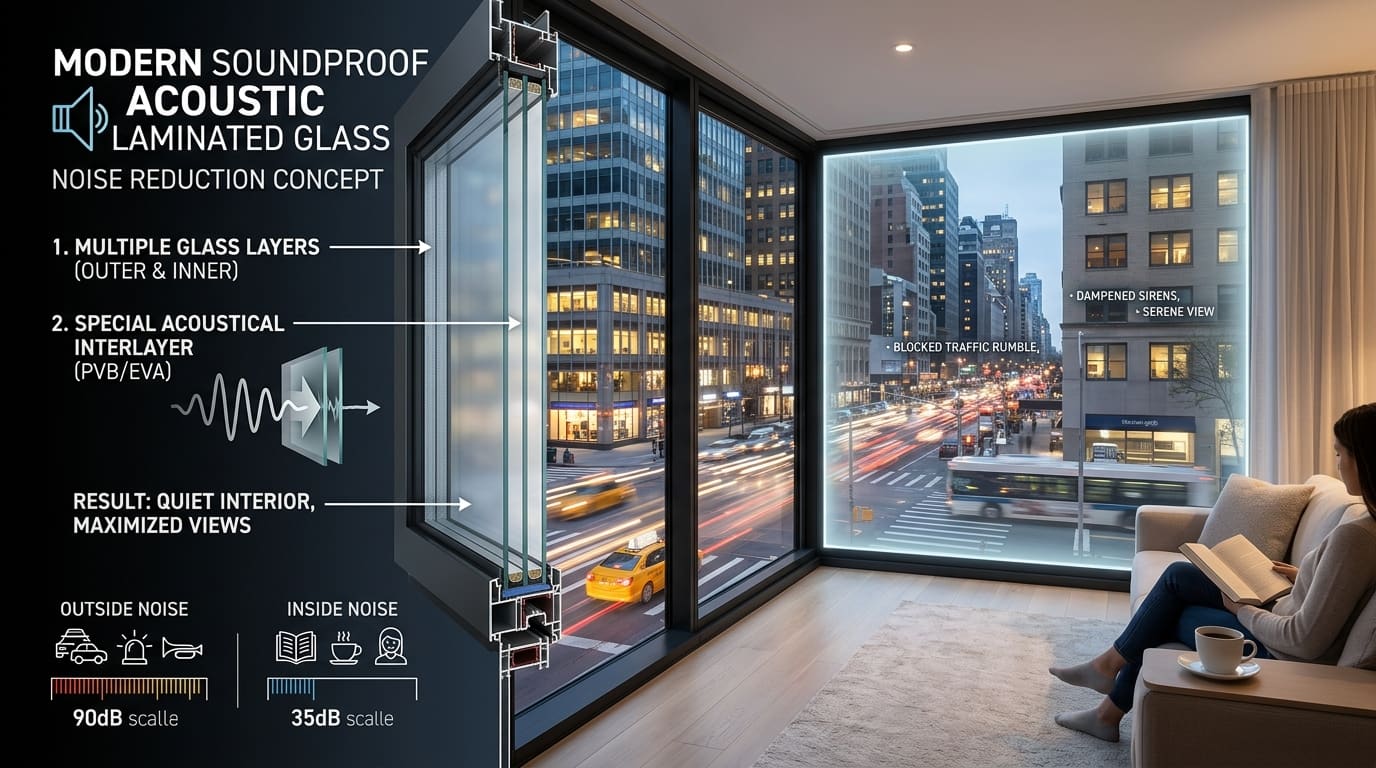
The effective approach is laminated glass — specifically, asymmetric laminated configurations. A window unit that combines a 3mm annealed laminated pane on one side with a 4mm or 5mm annealed or tempered pane on the other, with an airspace in between, breaks up the coincidence effect and adds the acoustic damping of the PVB interlayer. This combination can achieve Sound Transmission Class (STC) ratings of 38 to 48, compared to 26 to 28 for standard double-pane — a reduction that takes street noise from clearly intelligible to a distant background hum.
For the most demanding situations — a home office adjacent to a busy Rockville Pike corridor, a Silver Spring townhouse backing up to Metro operations, or a home near Reagan National flight paths in Arlington — we specify laminated acoustic glass with a specialized acoustic PVB interlayer rather than standard safety PVB. These products are marketed under names like Saflex Q Series or Solutia acoustic PVB and add another 3 to 5 STC points over standard laminated glass. Virginia Glass Windows can replace just the glass units in your existing window frames to deliver this upgrade without full window replacement.
Privacy: See the Screen, Not the Street
Privacy is a two-way concern in a home office: you may not want pedestrians or neighbors seeing your work, and you may find it distracting to see activity outside during focused work sessions. The glass solutions for these two concerns are different. For outward privacy — preventing people outside from seeing in — directional privacy films, etched glass, or PDLC switchable glass are the primary options. For managing the visual distraction of the outdoors during focused work, automated tinting or strategic window placement and interior treatment are more effective.
Frosted or etched glass in a home office window is the simplest privacy solution. It transmits light while obscuring the view from outside. The downside is that you also lose the view from inside, which many people value for mental health during long WFH days. A gradient-frosted glass — clear at the top to allow views of sky and trees, frosted at the lower portion where monitors and desks are visible from outside — is a solution we have done for several clients in Capitol Hill and Dupont Circle row houses with street-facing offices. It requires custom fabrication but is very effective.
PDLC switchable glass, covered in detail in our smart glass guide, is the premium solution for privacy-on-demand. Clear during video calls so clients or colleagues can see your professional background, opaque when you need to focus or when reviewing sensitive materials. For home offices in condos with close-in neighboring buildings — a common situation in NoVA high-rises and in the newer condo developments in Navy Yard and NoMa — PDLC glass gives you full control without permanent frosting. Virginia Glass Windows can specify and install PDLC for both full window replacement and as retrofit film on existing windows.
Glare Control: The Biggest Productivity Killer
Glare on monitors is the single most common complaint we hear from WFH clients. It is also the complaint where glass alone is not always the complete answer — monitor placement relative to windows matters enormously — but glass can make a significant difference. The culprit is usually direct solar penetration onto the work surface or specular reflection off surfaces in the room.
Low-E coatings are the starting point. All new insulated glass should have a low-E coating, and if your home office windows are older units without low-E, replacing the glass units is a significant quality-of-work-life upgrade. Low-E coatings selectively filter infrared radiation while transmitting visible light — meaning less heat, less glare-producing brightness, and cooler surface temperatures without substantially darkening the room. The specific low-E product matters: "solar control" low-E coatings (used in southern climates) block more visible light than "passive" low-E coatings (designed for northern climates to maximize winter solar gain). In the DMV, a moderate solar control low-E is usually the right call for south- and west-facing office windows.
For truly severe glare situations — a home office in a Bethesda colonial facing southwest with no tree cover, for example — spectrally selective window film is a cost-effective option that can be applied to existing glass. These films achieve visible light transmission of 50 to 70 percent while cutting solar heat gain coefficient to 0.25 or below. The best films are nearly invisible from outside and do not significantly alter interior color rendering. Virginia Glass Windows can evaluate your specific office orientation and recommend the most effective combination of glass or film solution for your situation.
Light Management: Getting the Light You Need, When You Need It
A well-lit home office reduces eye strain, improves mood, and makes video calls look more professional. The goal for glass is to maximize diffuse natural light while minimizing direct sun penetration that causes glare and heat gain. North-facing windows are ideal for home offices because they provide consistent, shadowless diffuse light without direct sun at any season — but most homes do not have a north-facing room that works as an office.
For east-facing offices, the challenge is morning direct sun that hits during the most productive hours. For west-facing offices, afternoon sun makes the second half of the workday uncomfortable. For south-facing offices, the sun angle varies dramatically between summer and winter — in winter the low sun angle drives deep solar penetration, and in summer the high angle hits skylights and low-slope roof glazing hard. Each orientation calls for a different glass specification and, potentially, different exterior shading elements.
Diffusing glass — also called translucent or satin glass — is an option worth considering for sidelight panels adjacent to office entry doors or for interior glass partitions in a home office. It transmits significant light while diffusing direct sun into pleasant ambient illumination. For the exterior window glazing itself, combining a solar control low-E coating with a light-colored interior roller shade gives you flexibility: open shades on overcast days for maximum daylight, closed shades on sunny afternoons to control glare while the low-E coating maintains some visible light transmission. Call (703) 470-7867 for a free home office glass assessment.
Practical Upgrade Path for DMV Home Offices
The most practical upgrade path depends on whether your existing window frames are in good condition and whether you are undertaking a broader renovation or addressing a specific pain point. If frames are good and the issue is sound, replacing just the glass units with laminated acoustic IGUs is the most cost-effective single upgrade. If the issue is glare and heat, replacing glass units with solar control low-E IGUs addresses both simultaneously. If the issue is privacy, PDLC retrofit film can often be applied to existing glass for significantly less than full unit replacement.
For new construction or major renovation, think about the home office from the start. North or northeast orientation is ideal. Operable windows (casement or awning style) provide better acoustic performance than double-hung windows because they seal more tightly when closed. Specify laminated glass in the outer pane of any IGU facing street or neighbor noise sources. Include a conduit path for smart glass wiring if you might want that capability in the future.
We offer free on-site assessments for home office glass projects throughout the DMV. One of our technicians will evaluate your office orientation, existing glass, noise levels, and work habits and give you an honest recommendation on the glass changes that will actually move the needle for you — and the ones that are not worth the cost for your specific situation. Reach us at (703) 470-7867 or submit a free photo estimate through our website.
Need Help With Your Glass?
Send us a photo of your window or glass issue and get a free estimate within hours. Our experts serve all of DC, Maryland, and Virginia.
Common Questions
Frequently Asked Questions
Answers to common questions about this topic from our DMV glass experts.
Keep Reading
Related Guides
Explore More Resources
Related Articles
Common Problems
Related Pages
Our Services
Ready to Get Started?
Get a free estimate from our glass experts. Same-day service available across DC, MD & VA.