Insulated glass unit replacement
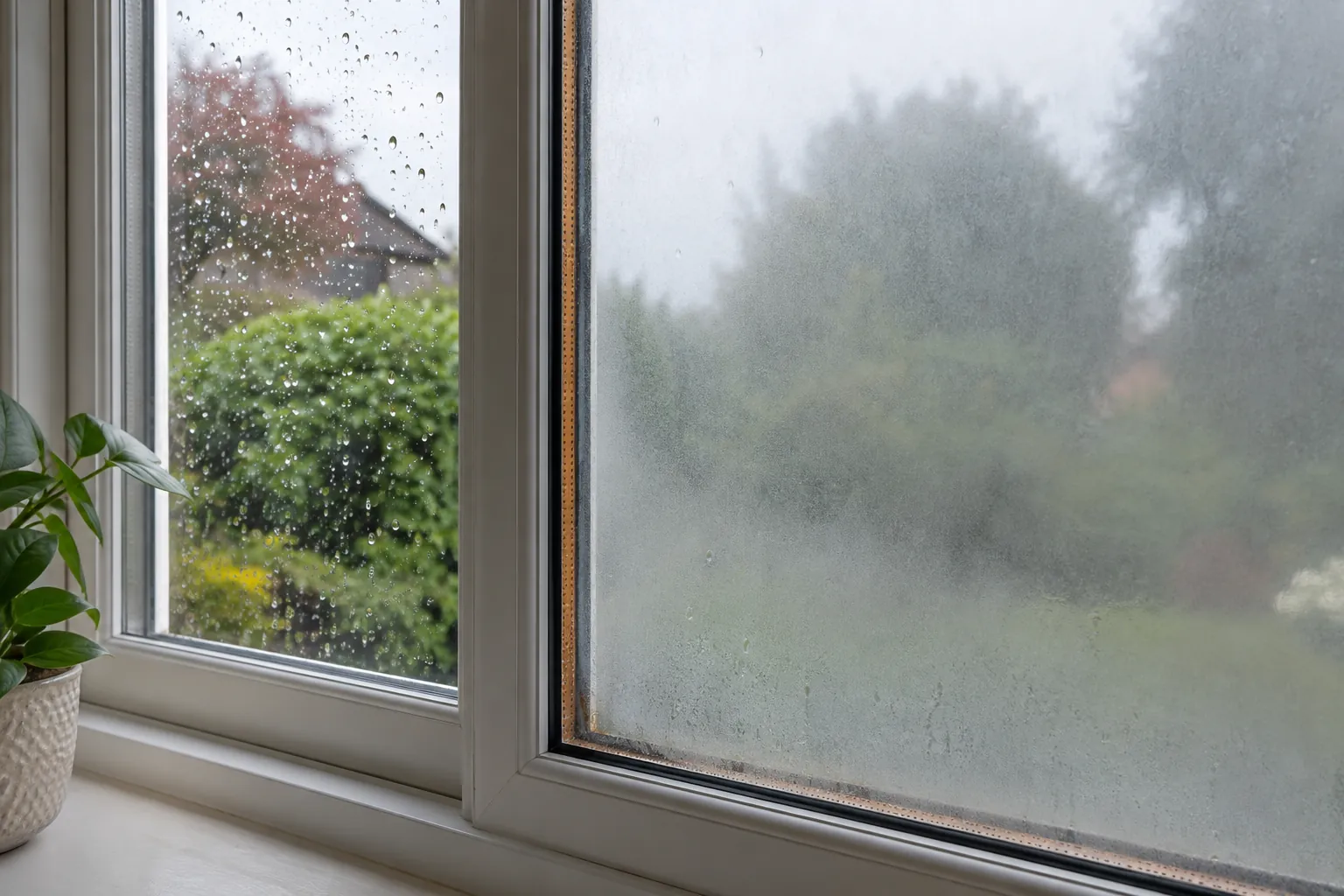
The fog is insidea sealed cavity
Condensation between the panes is not dirt and it is not a cleaning problem. The hermetic seal around the glass has opened, the gas fill has gone, and humid air is now cycling in and out of a space you cannot reach. We replace the sealed unit inside your existing frame and leave the window itself alone.
- ②
- Coating surface we match
- 1/2 in.
- Standard cavity width
- R308.4
- Safety glazing checked
Bonded & Insured
Residential and commercial
24/7 Emergency
Seven days a week
Free Estimates
No obligation
Locally Owned
Residential and commercial
Upfront Pricing
Never an overtime charge
Detail 01
What a sealed unit is, and what breaks
A vertical cut through the bottom edge of a double-glazed unit sitting in its pocket. Switch the seal state to see exactly what changes when the perimeter opens up.
D-01 · IGU edge section
Scale NTS
Reading the drawing
Glazing surfaces are numbered from the outside in. Say “Low-E on two” to a glazier and they know precisely which face of which lite you mean.
- 1
Outer face of the exterior lite
Weather side. Rain, road film and the squeegee live here.
- 2
Cavity face of the exterior lite
Where the Low-E coating belongs in a heating-dominated climate. It reflects long-wave heat back into the room and is sealed away from the air.
- 3
Cavity face of the interior lite
The surface fog forms on. Once minerals from evaporated condensate etch it, no cleaning reaches it.
- 4
Room face of the interior lite
The only interior surface you can actually wipe.
- A
Polyisobutylene primary seal
A thin butyl bead between spacer and glass. It is the moisture-vapour barrier — the part that actually keeps humidity out.
- B
Desiccant-filled spacer
A hollow bar perforated on the cavity face. The desiccant inside absorbs the small amount of moisture sealed in at the factory.
- C
Silicone secondary seal
The structural bond that holds the two lites together and carries edge loads. Fails first under UV and movement.
- D
Setting blocks
Neoprene blocks at the quarter points. They keep the glass edge off the frame so the seal never bears the unit weight.
- E
Weep
The drainage path out of the glazing pocket. Blocked weeps stand water against the secondary seal and shorten its life.
Failure modes
Six ways an edge seal gives up
Seals do not fail at random. Every one of these leaves evidence a technician can read at the opening, which is how we tell you whether the frame needs work too.
Secondary seal failure
The silicone or polysulfide bond around the perimeter loses elasticity, cracks and pulls away from the spacer. Once that structural seal opens, the butyl behind it is exposed and the unit is no longer hermetic. This is the single most common failure mode.
Thermal pumping
Sealed cavity air expands in sun and contracts at night, flexing both lites in and out. In the DMV, where summer surface temperatures and January nights are separated by more than a hundred degrees, that cycle runs thousands of times over a unit life and works the seal loose.
Ultraviolet breakdown
UV cleaves the polymer chains in organic sealants. South and west elevations take the most exposure and consistently fail before north-facing units in the same house. It is why the edge cover of the frame matters: sealant shaded by the glazing bead lasts longer.
Poor glazing pocket
No setting blocks, no weeps, or the unit shimmed at the wrong points. The glass edge ends up bearing load or sitting in water, and the seal carries stress it was never designed for. Units glazed like this can fog within a few seasons.
Standing water at the edge
A split perimeter caulk joint or failed head flashing sends water into the pocket. Constant wetting attacks the secondary seal far faster than ambient humidity. The frame problem has to be corrected during replacement or the new unit fails the same way.
Gas loss
Argon permeates slowly through any organic seal — that is normal and accounted for. Once the seal is compromised the rate climbs, the cavity depressurises relative to outside, and humid air is drawn in behind the escaping gas.
What you are seeing
Symptoms, in the order they usually appear
Early failure is intermittent and easy to dismiss. By the time the haze is permanent, surface ③ has been etched and the glass itself is damaged.
Condensation between the panes
Droplets or a running film you can see but cannot reach from either side. Usually worst first thing in the morning and after a temperature swing.
Persistent milky haze
The glass reads dirty immediately after cleaning both accessible faces. That haze is inside the sealed cavity.
Rippled or distorted view
Mineral residue on surface ③ scatters light and puts a visible waviness into anything seen through the unit.
Fog that comes and goes
Appearing on cool mornings and clearing by afternoon means moisture is present but the cavity is not yet saturated. This is early-stage failure.
Chalky white deposits
Permanent etch where condensate evaporated and left its dissolved minerals behind. At this point the surface itself is damaged, not just wet.
A cold band near the glass
Lost gas fill shows up as a noticeably colder zone in front of the window during a cold snap, often with condensation on surface ④.
Method
How the replacement actually runs
Survey every opening
We work the whole house, not just the window you called about. Each unit is checked for seal condition and we separate active condensation from permanent mineral etch, because those two findings have different urgency.
Record the make-up
Daylight opening, overall unit size, glass thickness, spacer width, coating position and gas fill. Getting surface ② right is what makes the replacement behave like the rest of the house.
Deglaze cleanly
Beads or stops come off intact, the failed unit is lifted out, and the pocket is cleaned back to bare frame. We check for rot, blocked weeps and missing setting blocks while it is open.
Glaze the new unit
Factory-sealed unit set on fresh neoprene blocks at the quarter points, correct edge clearance all round, new gaskets or glazing compound, stops refitted square.
Verify and hand back
Sash operation, lock engagement, weep flow and a clean sight line checked in front of you, with care notes for the new glass.
Detail 02
Unit make-ups we fabricate and match
Each drawing is a horizontal section with the exterior at the left. The tinted band on a lite marks a coated surface.
Double glazed
Two lites, one cavity. The configuration in most DMV homes built or re-windowed since the 1980s, and the one we replace most often.
Triple glazed
Three lites and two cavities. Found in newer high-performance builds; the centre lite makes the unit heavy, so frame and hardware condition matter.
Low-E on surface ②
A microscopically thin silver-based stack facing the cavity. Uncoated glass has an emissivity near 0.84; a soft-coat Low-E surface sits at or below 0.04.
Argon filled
Argon conducts heat at roughly 0.018 W/m·K against about 0.026 for air, so the same cavity insulates better simply by changing what is in it.
Krypton filled
Krypton performs in a narrow cavity where argon cannot, which is why it turns up in triple units and in retrofits with shallow frame depth.
Grille between the glass
Muntin bars sealed inside the cavity. We match bar profile, width and layout so a replaced unit does not read differently from the one beside it.
Numbers that are checkable
Why the make-up matters more than the sales sheet
These are properties of the materials, not claims about a job. They are the reason a correctly specified replacement performs like the window it sits beside.
1/2 in.
12.7 mm
Cavity width where an argon fill performs best. Wider gaps start losing to convection.
0.04
emissivity
Typical soft-coat Low-E surface, against roughly 0.84 for uncoated glass.
0.018
W/m·K
Thermal conductivity of argon. Air is about 0.026 — same gap, less heat through it.
R308.4
IRC
Safety glazing locations. Units in hazardous locations come back as tempered or laminated, not annealed.
What the DMV climate does to a seal
This region runs one of the wider annual temperature bands on the East Coast: summer glass surface temperatures well above ambient, January nights below freezing, and high summer humidity in between. Every swing pumps the sealed cavity in and out, and every one of those cycles works the perimeter seal. A south or west elevation takes the UV load on top of it, which is why those windows in a house of the same age are usually the first to haze over.
Send us the window
A photo of the glass and a shot of the sash edge is usually enough for us to tell you what we are dealing with. Or call and we will book the survey.
Questions
Foggy window repair, answered
A failed edge seal on the insulated glass unit. Two lites of glass are bonded around a spacer with a butyl vapour barrier and a structural silicone seal, and the cavity between them is sealed at the factory. When that assembly opens up, insulating gas leaves and humid outside air comes in. Every time the glass drops below the dew point of that trapped air, moisture condenses on the cavity faces — surfaces ② and ③ — where nothing you can hold will ever reach it.
No. The fog is inside a sealed assembly. Cleaning surface ① and surface ④ has no effect on the two surfaces facing the cavity, because you cannot get to them without breaking the unit apart. Replacing the sealed unit is the only outcome that restores both clarity and insulating performance.
Drilling a port, flushing the cavity and fitting a breather vent will often clear the visible haze. What it does not do is restore the unit: the cavity is now vented to outside air, the gas fill is gone permanently, and the desiccant is spent. Any mineral etching already on surface ③ stays there. We do not offer it, because the unit still has to be replaced later and nothing about the thermal performance comes back.
No, and in most cases it should not be. We replace only the sealed glass unit inside the existing sash or frame. Frame, hardware, trim, weatherstrip, exterior finish and the wall opening are all left alone. Full window replacement is the right call when the frame itself is rotted, racked, or the sash no longer holds square — and we will tell you when that is what we are looking at.
Survey and measure is one visit. Custom units are typically fabricated in three to five business days. Installation runs roughly thirty to sixty minutes per opening, so most houses are finished in a single installation day. From first call to clear glass is usually seven to ten business days.
That is the whole job. We match overall thickness, lite thickness, tint, spacer type and colour, coating position and gas fill, plus grille profile and layout where there is one. Get the coating on the wrong surface and the replacement reads differently in daylight and behaves differently in winter, which is exactly the mistake we are measuring to avoid.
The moisture inside the cavity is contained, but the conditions that produced it often are not. A unit with no gas fill runs cold enough to condense room air on surface ④, and that water runs down onto the sill and the frame. Wood sills swell, paint lifts, and the glazing pocket stays wet. Where the fogging came from a leaking joint or blocked weeps in the first place, that frame problem is still live until it is corrected.
Three things do most of the work: warm-edge spacer and dual-seal construction in the unit itself, a glazing pocket that drains — clear weeps, setting blocks at the quarter points, correct edge clearance — and perimeter sealant that is maintained rather than left split. We correct the pocket while the sash is open, which is the part a straight glass swap usually skips.
Only the failed ones, in most houses. Units that are still sealed are doing their job and there is no performance reason to disturb them. Where a run of windows went in at the same time and several are already showing early haze, doing them together means one measure, one fabrication run and one install day. We give you the condition of every opening and let you decide the order.
We work across Washington DC, Northern Virginia and the Maryland suburbs — the full list of communities is on our service area page. If you are unsure, call (703) 470-7867 and we will tell you straight away.
Related services
Explore More Resources
Helpful Guides
Related Articles
Common Problems
Related Pages
Our Services
Etching is permanent. Fogging is not the end of it.
Once condensate has evaporated and left minerals on surface ③, that damage stays in the glass. Catching a failed seal early keeps the job to a straight unit swap.
Call (703) 470-7867