Soundproof Windows: How to Reduce Noise in Your DMV Home
Tired of noise? Virginia Glass Windows explains soundproof window options, STC ratings, acoustic glass, and the best noise reduction solutions for homes near roads, airports, and Metro.
Why DMV Homes Need Soundproof Windows
The Washington DC metropolitan area is one of the noisiest urban regions in the country. Constant traffic on the Beltway, I-66, I-95, and I-270. Metro trains running through neighborhoods. Aircraft approaching Reagan National and Dulles. Construction booming across Arlington, Tysons, and Silver Spring. For hundreds of thousands of DMV residents, exterior noise is a daily quality-of-life issue.
Windows are the weakest link in your home sound barrier. Standard windows block only 25 to 28 STC (Sound Transmission Class) — barely enough to make outdoor conversation difficult to hear. Upgrading to acoustic windows with STC ratings of 35 to 45 makes exterior noise barely perceptible indoors.
Understanding STC Ratings
STC (Sound Transmission Class) measures how much sound a window blocks. Each 10-point increase in STC roughly halves the perceived sound volume. Standard single pane glass rates around STC 26. Standard double pane rates STC 28 to 32. Acoustic glass achieves STC 35 to 45.
For context: STC 25 means loud speech is easily understood through the window. STC 35 means loud speech is audible but not understood. STC 45 means loud speech is barely audible. Most DMV homeowners seeking noise reduction need STC 38 or higher.
STC ratings are measured for the entire window assembly, not just the glass. Frame material, weatherstripping quality, and installation technique all affect the final STC rating. A premium acoustic glass panel installed in a poorly sealed frame underperforms.
Acoustic Glass Technology
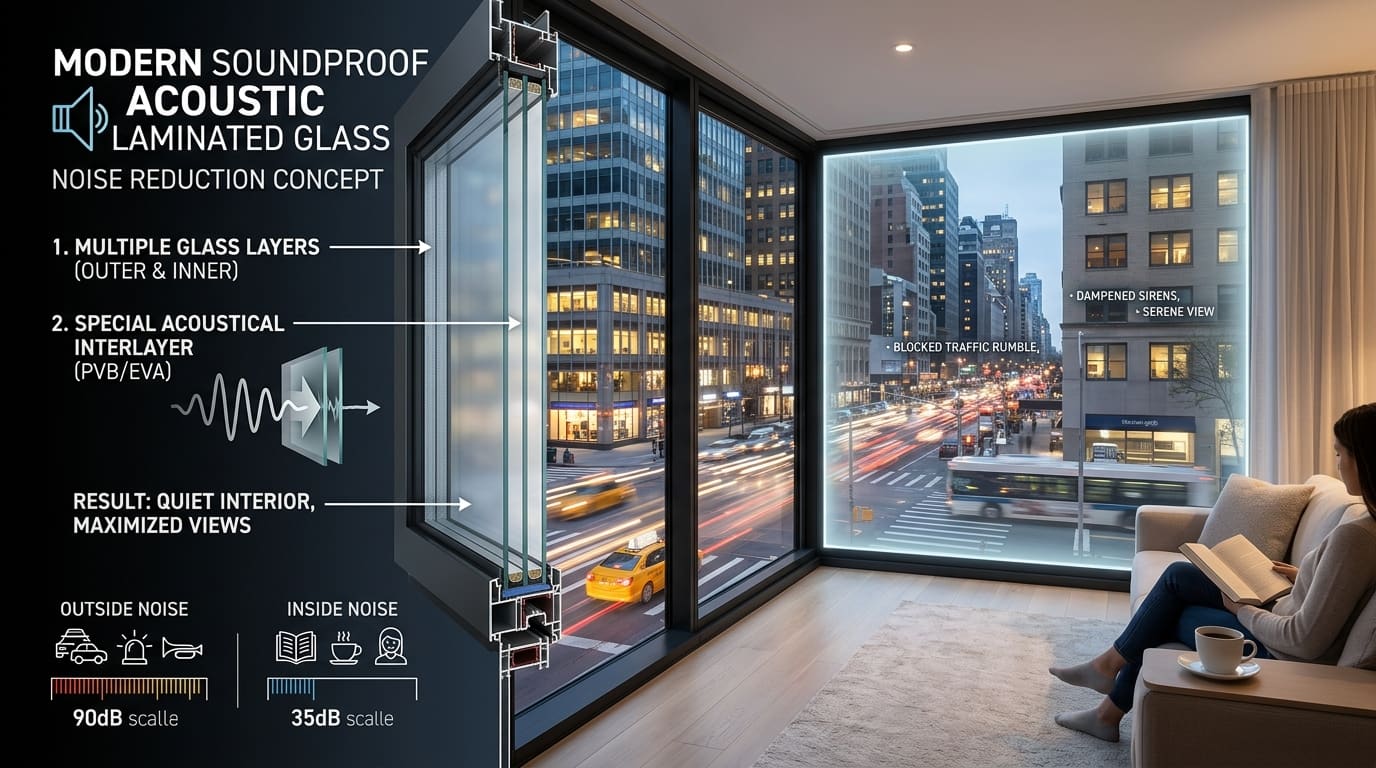
Acoustic glass uses laminated construction with a special acoustic PVB (polyvinyl butyral) interlayer that is specifically formulated to dampen sound vibrations. Unlike standard laminated glass that uses a structural PVB, acoustic PVB is softer and more effective at absorbing sound energy.
Asymmetric glass configurations further improve sound reduction. By using two different thicknesses of glass (for example, 3mm and 5mm instead of two 4mm panes), the window disrupts sound waves across a broader frequency range. This is especially effective against traffic noise, which spans multiple frequencies.
For maximum noise reduction, acoustic laminated glass in an insulated glass unit with argon gas fill achieves the best combination of sound blocking and thermal performance. This is the configuration we recommend for DMV homes with serious noise concerns.
Interior Storm Windows for Noise Reduction
Interior storm windows are an affordable alternative that creates a secondary glass barrier inside your existing windows. By adding an additional air gap between the storm window and the primary window, sound transmission is dramatically reduced.
Interior storm windows work particularly well in older DMV homes where the existing windows have historic value and cannot be replaced. The storm window provides noise reduction without altering the exterior appearance.
For maximum effectiveness, the air gap between the primary window and storm window should be at least 2 to 4 inches. Thicker gaps provide better low-frequency noise reduction (traffic rumble, bass).
Which DMV Neighborhoods Benefit Most
Homes along I-66 corridor through Arlington and Fairfax experience constant highway noise. Acoustic glass on highway-facing windows is transformative for these properties.
Properties near Reagan National Airport in Crystal City, Pentagon City, and Alexandria experience frequent aircraft noise. Acoustic glass combined with proper weathersealing significantly reduces flight noise intrusion.
Homes along Metro corridors in Silver Spring, Bethesda, Arlington, and Tysons experience train noise and vibration. Acoustic glass addresses the airborne noise component while mass-loaded solutions may be needed for vibration.
Urban condos and apartments in downtown DC, Bethesda, and Arlington face multi-source noise from traffic, construction, and nightlife. Acoustic glass provides a quiet retreat within the urban environment.
Need Help With Your Glass?
Send us a photo of your window or glass issue and get a free estimate within hours. Our experts serve all of DC, Maryland, and Virginia.
Common Questions
Frequently Asked Questions
Answers to common questions about this topic from our DMV glass experts.
Keep Reading
Related Guides
Explore More Resources
Related Articles
Common Problems
Our Services
Ready to Get Started?
Get a free estimate from our glass experts. Same-day service available across DC, MD & VA.