Commercial service 24/7 Emergency

Glass Garage Door Servicein DC, MD & VA

Full-view aluminium sectional doors — the glazed overhead doors on breweries, showrooms, fire stations, car washes and an increasing number of DMV houses. We replace broken and fogged lites, re-glaze whole sections, and specify the make-up for new doors: single or insulated, clear, obscure, tinted or Low-E, with the counterbalance re-rated when the weight changes.

  • 24/7 Emergency Service
  • DC · Maryland · Virginia
  • Free photo estimates

Bonded & Insured

Residential and commercial

24/7 Emergency

Seven days a week

Free Estimates

No obligation

Locally Owned

Residential and commercial

Upfront Pricing

Never an overtime charge

24/7

Emergency dispatch

DC/MD/VA

All three jurisdictions

Tempered

Safety glazing to code

Templated

To your exact opening

Types we handle

Glass Garage Door Service: what we work on

Each of these is a different assembly with its own hardware, tolerances and code path. Drawings, not stock photos.

Full-vision storefront bay, elevationThree uninterrupted tempered lites carried between a continuous aluminium head and sill, split by two vertical mullions and set on the sidewalk line.

Full-View Aluminium Sectional Doors

Extruded aluminium stiles and rails glazed in every opening, hinged section to section, running in vertical track through a radius into horizontal track overhead. The standard full-view door for breweries, showrooms, restaurants with an opening wall, and residential garages that double as living space.

Insulated glass unit, section through the edgeTwo lites of glass separated by an argon-filled cavity. The low-emissivity coating sits on surface two, the room side of the outboard lite. A warm-edge spacer holding desiccant is bedded on a primary seal, with a secondary seal closing the edge.1234LOW-E #2ARGONSPACERSEAL

Insulated Glazed Sections

Two lites, a spacer, argon in the airspace and a low-emissivity coating on surface #2, set in a thermally broken extrusion. The right specification for a conditioned garage or an occupied space behind the door, and materially heavier than single glazing — which the springs have to account for.

Thermally broken aluminium jamb, sectionSection cut through the jamb showing the glazing pocket, the setting block carrying the sealed unit, and the bead that traps it.SETTING BLOCKBEAD

Single-Glazed Sections

One lite per opening in a plain aluminium rail. Lighter, simpler, and the usual specification where the space behind the door is unconditioned. In a heated garage a single-glazed aluminium door will run with condensation in cold weather, and that is physics rather than a defect.

Insulated glass unit, section through the edgeTwo lites of glass separated by an argon-filled cavity. The low-emissivity coating sits on surface two, the room side of the outboard lite. A warm-edge spacer holding desiccant is bedded on a primary seal, with a secondary seal closing the edge.1234LOW-E #2ARGONSPACERSEAL

Obscure, Tinted and Low-E Lites

Frosted and satin-etched glass for privacy on a street-facing garage, bronze and grey tints for glare, mirrored and reflective finishes for daytime privacy, and Low-E coatings for solar control. All of them can be specified section by section, so the bottom row can be private and the top row clear.

Laminated security glass, sectionTwo lites bonded to a polyvinyl butyral interlayer. An impact fractures the outboard lite, but the interlayer holds the fragments and the opening stays closed.PVB INTERLAYERFRAGMENTS HELD

Acrylic and Polycarbonate Panels

Where impact resistance matters more than optical quality — car washes, service bays, buildings that keep losing lites. Both take a hit that would break glass, both scratch more easily, and both move considerably more with temperature, which changes how the pocket has to be glazed.

Impact fracture, elevationRadial cracks running out from the point of contact, crossed by concentric rings closest to the strike.

Impact, Storm and Break-In Damage

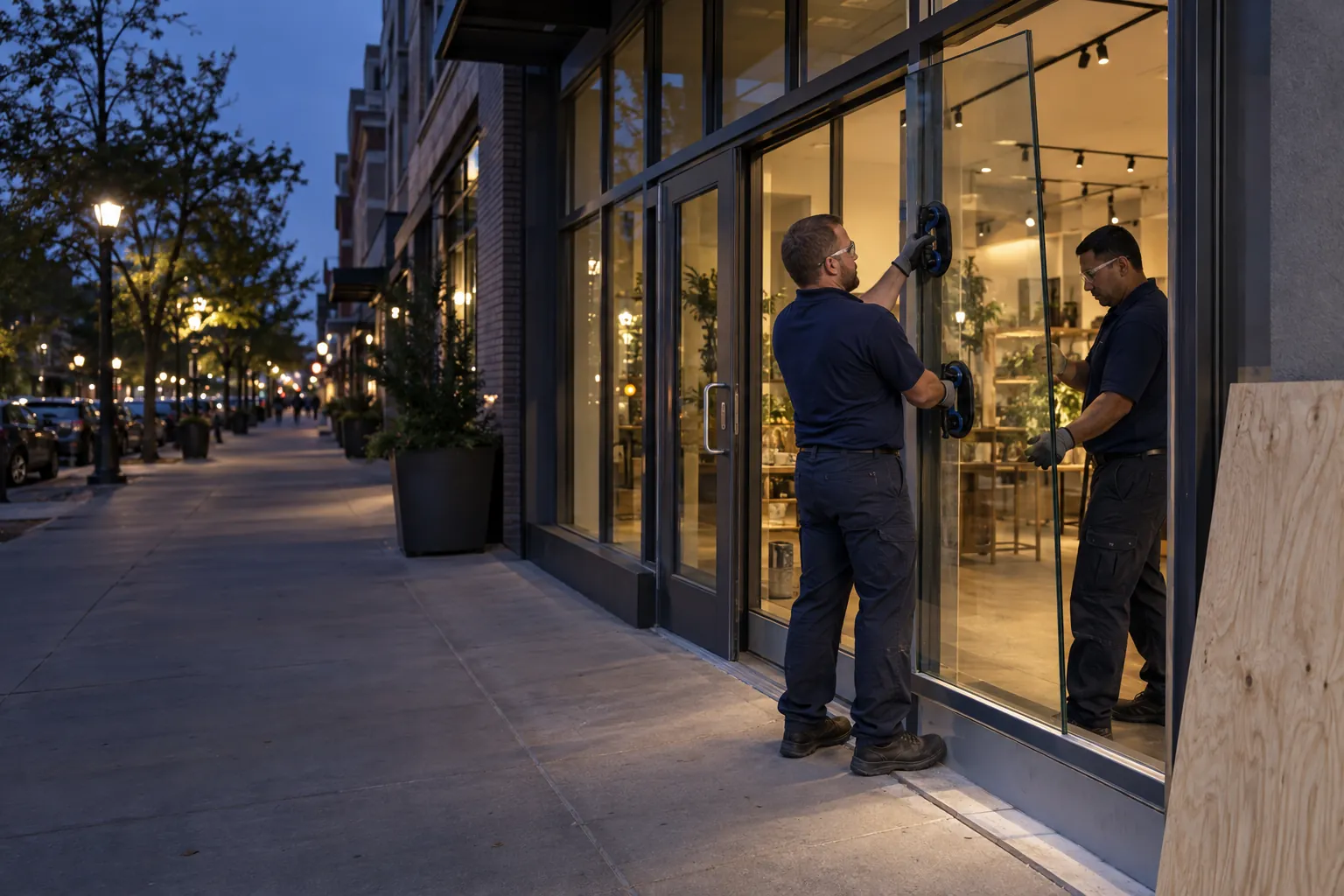
A backed-into section, storm debris, or a forced lite on a ground-floor commercial door. We secure the opening on the first visit, then re-glaze the affected lites or replace the section, matching the existing glazing make-up so the door still balances.

Every hour costs you more

Why you need glass garage door service now

Delaying repair doesn't save money — it multiplies the damage.

01

A Broken Section Is an Open Building

A garage door is the largest opening in the envelope. One lite out of a full-view door on a commercial elevation is a way in, a weather breach and, in a leased building, usually a notice item. This is a secure-first, glaze-second job.

02

The Door No Longer Balances

A sectional door is counterbalanced by torsion springs sized to its weight. Replace single glazing with insulated units, or glass with acrylic, without re-rating the springs and the door becomes heavy or light — and the opener, the cables and the drums take the difference.

03

Condensation and Heat Through the Aluminium

Aluminium conducts. A full-view door without a thermal break, or with single glazing behind a conditioned space, runs with condensation in winter and radiates heat in July. It is the largest single thermal weakness in most buildings that have one.

04

Damage Spreads Across the Assembly

A section that has been struck rarely stops at the glass. Bent end stiles, a tweaked track, a flat spot on a roller and a stretched cable all follow, and a door run in that state grinds its own track. The assembly is worth inspecting even when only the lite looks broken.

What You Get

Glass Garage Door Service Benefits

Every service comes with our commitment to quality, speed, and transparency.

01

Lite Replacement, Not Door Replacement

Individual lites come out of the rail pocket and go back in. A broken pane in one opening does not mean a new section, let alone a new door.

02

Make-Up Matched to What You Have

Thickness, tint, obscure pattern, Low-E and whether the lite is single or insulated are all recorded from the existing door so the repaired section matches the rest.

03

Counterbalance Checked

When the glazing make-up changes the door weight, we say so and address the spring rating rather than leaving the opener to absorb it.

04

Secure the Opening First

24/7 dispatch. A breached section on a commercial elevation gets closed on the first visit, permanent glazing after.

05

Commercial and Residential

Breweries, showrooms, car washes, fire stations and service bays, and the residential full-view doors that have become common across the DMV.

06

Whole Assembly Inspected

Track, rollers, hinges, end stiles, cables and the bottom seal get looked at while we are in the door, because impact damage rarely stops at the glass.

Glass Garage Door Service on a job site in the DMV
Insulated glass unit, section through the edgeTwo lites of glass separated by an argon-filled cavity. The low-emissivity coating sits on surface two, the room side of the outboard lite. A warm-edge spacer holding desiccant is bedded on a primary seal, with a secondary seal closing the edge.1234EXTERIORINTERIORLOW-E COATING — SURFACE 2ARGON-FILLED CAVITYWARM-EDGE SPACER + DESICCANTSECONDARY SEAL
Sealed unit — edge section
The detail behind it

Specified before it is ordered

Every glass garage door service job starts with the assembly, not the pane. What the frame is, how the glass is captured, which code applies to that opening — those decide the specification, and the specification decides whether the repair lasts.

  • Safety glazing specified to the code for the opening
  • Same-day service for most jobs
  • Free photo estimates with no obligation
  • Bonded and insured, residential and commercial

Get a Free Glass Garage Door Service Estimate

Upload photos of the glass and we will come back with an itemized estimate. No home visit needed, no obligation.

Upload Photos Now
Our Process

How Glass Garage Door Service Works

A simple, transparent process from first contact to completed job.

01

Photos of the Door and the Plate

The whole door from outside, the manufacturer plate inside a section or on the track, and the damage. That identifies section height, lite size and make-up.

02

Secure If It Is Breached

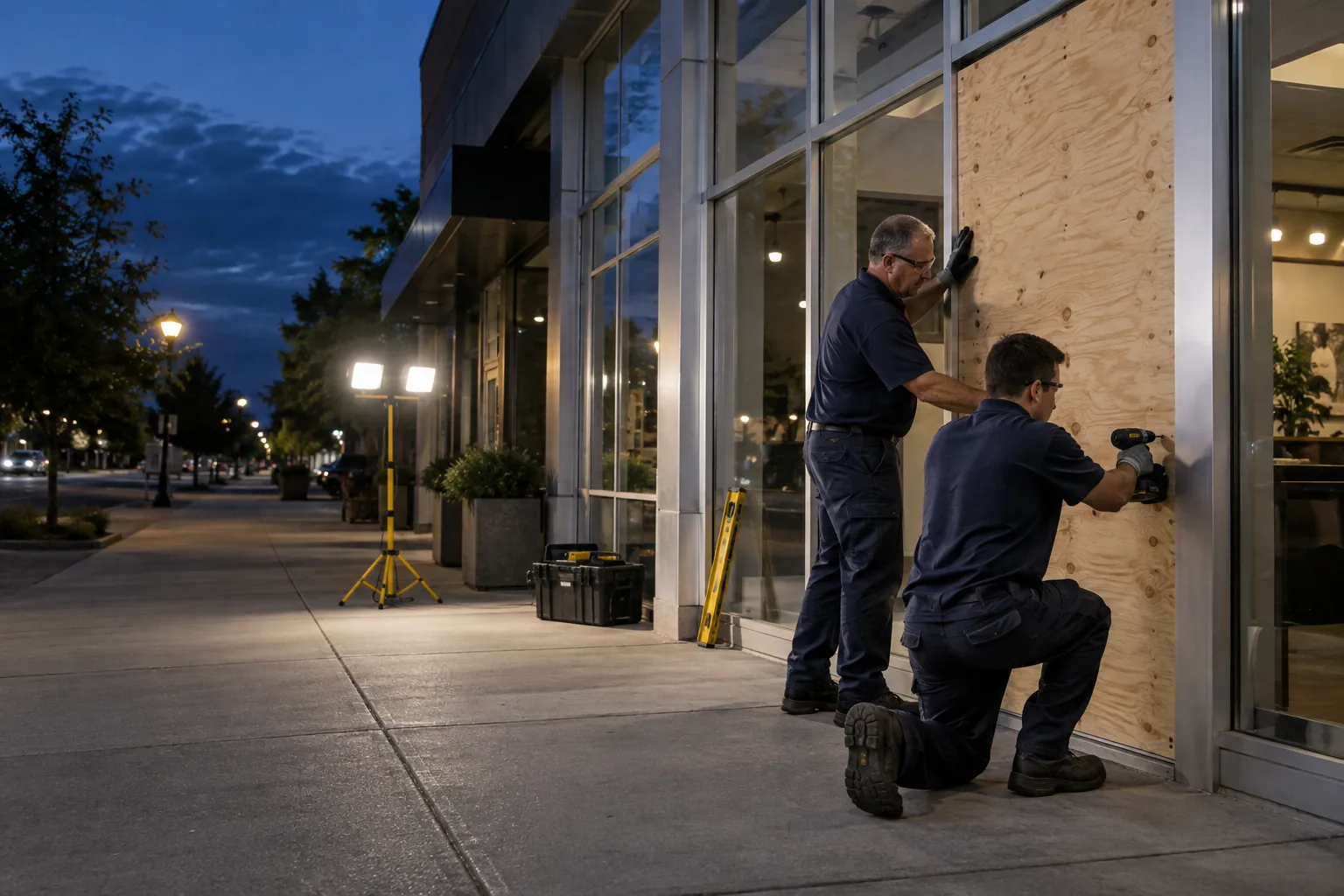
A commercial or ground-floor opening with a lite out is closed on the first visit — panelled or filmed — before anything is ordered.

03

Measure and Specify

Lites are measured out of the pocket, not off a drawing. We record thickness, tint, obscure pattern, coating and whether the unit is insulated.

04

Re-Glaze the Section

Retainer out, damaged lite out, pocket cleaned, new lite set and the retainer snapped back. Whole sections are swapped where the extrusion itself is damaged.

05

Balance and Cycle

The door is balanced by hand, the spring rating checked against the finished weight, and then run through full open and close cycles with the operator before we leave.

The Transformation

Before & After Glass Garage Door Service

Before

Damaged, inefficient glass compromising safety and comfort.

After

Crystal-clear, professionally installed glass restoring beauty and performance.

Warning Signs

Signs You Need Glass Garage Door Service

A cracked, shattered or missing lite in one of the sections.
Haze or a tidemark between the panes of an insulated lite.
A section that has been struck and is visibly bowed or out of line.
A door that drops when you release it half open, or drifts up on its own.
A retainer that has come out of the pocket or a lite that rattles in its opening.
Condensation running down the inside faces of the rails on cold mornings.
Grinding, banging or a flat-spotted roller as the door runs the track.
Frayed lift cable, or one cable slack while the other is tight.
A bottom seal that no longer touches the slab across the full width.
A door that will not close and reverses part way, which is usually the photo-eyes.

What a Full-View Door Actually Is

A full-view or full-vision door is a sectional overhead door whose sections are extruded aluminium stile-and-rail frames rather than steel panels, with a lite in every opening. Four sections is the usual arrangement on a seven-foot opening, each divided by intermediate stiles into three to six lites depending on the width. Every joint between sections is a hinge line, and every hinge line carries a roller at each end that runs in the vertical track. The whole assembly is counterbalanced by torsion springs on a shaft above the header, with cables running from the bottom brackets to drums at each end of that shaft. Understanding that the door is a chain of hinged frames rather than a single slab explains almost everything else about how it fails and how it is repaired.

Panel Stack Geometry: Headroom and Backroom

A sectional door does not lift. It folds. As it opens, the bottom section rises in the vertical track while the top section has already flattened out onto horizontal track running back under the ceiling, and one section at a time articulates through the radius between them. That geometry sets two dimensions the building has to provide: headroom, the space between the head of the opening and the ceiling or any obstruction, and backroom, the depth the horizontal track needs behind the opening, which is roughly the door height plus another foot and a half. Where the headroom is not there, low-headroom track arrangements exist. Where a building needs the door to go straight up — a service bay with a lift behind it — high-lift and vertical-lift arrangements do that, with different track and a different drum. These are the questions to settle before glazing is even discussed.

Whatever Goes in the Lite Changes the Weight of the Door

This is the single most commonly ignored fact about glazed sectional doors. The torsion springs are wound and sized for a specific door weight. Swap single glazing for insulated units across a full-view door and you have added a substantial amount of glass; swap acrylic for glass and you have added more still. The door will then be heavier than its counterbalance, which means it drops when released, the opener works against a load it was not sized for, and the cables and drums take the difference. Re-rating the springs is part of the job, not an upsell, and any conversation about upgrading the glazing in a full-view door that does not mention the counterbalance is incomplete. Torsion springs store a great deal of energy and are not a homeowner adjustment.

Safety Glazing, and Where It Is Actually Required

A sectional overhead door is not a swinging, sliding or bifold door, so the door-glazing provision at IRC R308.4.1 does not automatically catch it the way it catches a French or entry door. Whether a given lite is a hazardous location depends instead on the glazing-in-windows criteria at R308.4.3 and IBC 2406.4.3 — pane area, how close the bottom edge sits to the floor, how high the top edge reaches, and whether there is a walking surface within thirty-six inches horizontally. Lower sections on a full-view door frequently meet those tests, and manufacturers commonly specify tempered glass in the lower sections as standard regardless. Our position is straightforward: we glaze to whatever the adopted code requires for that opening in Virginia, Maryland or the District, and where the code is silent we recommend tempered anyway, because these lites sit at knee and chest height in a space people walk through.

Thermal Performance and Condensation

Aluminium is an excellent conductor, which is exactly what you do not want in a building envelope. A full-view door in a conditioned space needs two things to behave: insulated glazing units rather than single lites, and a thermally broken extrusion, where a polyamide strut poured into the rail separates the outer half of the section from the inner half. Without the break, the inside face of the aluminium tracks the outside temperature and condensation forms along every rail on a cold morning. With insulated units the coating position matters as well — a low solar gain Low-E on surface #2, the inboard face of the outer lite, rejects solar infrared before it enters the airspace, which is the right choice for the mixed climate here. None of this makes a glazed door thermally equal to an insulated steel sandwich door, and anyone claiming otherwise is selling something.

Wind Load, Track and Reinforcement

The garage door is the largest opening in most buildings that have one, and a door that fails in a storm depressurises the building from the inside. Wind-load-rated doors use heavier gauge track, additional struts across the back of each section, and reinforced end stiles and brackets, and they are tested to the industry standard for the design pressure at the site. If your building is being permitted for new work, the design pressure will come out of the structural documents; if you are replacing glazing in an existing rated door, it matters that the replacement lites and any section swap keep the door as tested rather than quietly downgrading it. We ask about this on commercial work as a matter of course.

Operators, Photo-Eyes and What Not to Skip

Any powered sectional door needs external entrapment protection — the photo-eye pair mounted low across the opening that reverses the door if the beam is broken. Residential operators have been required to carry it under UL 325 since the early 1990s, and misaligned or dirty eyes are the single most common reason a door refuses to close. Commercial installations add their own requirements depending on how the door is activated and whether it is in a path of travel. When we are in a door for glazing we check that the eyes are aligned and clean and that the door reverses on obstruction, because it takes a minute and it is the safety device most likely to have been quietly bypassed.

For Every Property

Residential & Commercial Glass Garage Door Service

Residential glass garage door service

Residential Glass Garage Door Service

Professional service for homes, condos, and townhomes across the DMV.

Commercial glass garage door service

Commercial Glass Garage Door Service

Serving offices, retail, restaurants, and buildings of any scale.

Common Questions

Glass Garage Door Service FAQ

Yes, and it is the normal repair. Each lite sits in a pocket formed by the aluminium rail with a snap-in vinyl retainer holding it. We take the retainer out, remove the damaged lite, clean the pocket and set the replacement, then snap the retainer back. The section stays on the door and the door stays in the track. Whole sections are only replaced when the extrusion itself is bent or the end stile has been damaged, which happens when something has hit the door rather than just the glass.

Work we stand behind

See the work, then judge it

Virginia Glass Windows is locally owned and has been doing residential and commercial glass across Northern Virginia, DC and Maryland for over a decade. Bonded and insured, on call around the clock.

24/7 Emergency Service

Glass Garage Door Service Emergency? Call Now.

Call the dispatch line and we will get a crew out to secure the opening.

(703) 470-7867
Shop drawings

A full-view door is an extrusion with a counterbalance attached

The glass is the part everyone looks at. The four things that decide whether it works are the section geometry, the track, what goes in the lite, and whether the springs are rated for it.

G-01 · Full-view sectional door, elevation

G-01 · FULL-VIEW SECTIONAL DOOR, ELEVATIONtorsion spring, sized to the doorcable drumrollerstrutsealintermediate stileopening widthEvery section joint is a hinge line, and every hinge line has a roller at each end.Change what is in the lites and you change the door weight — which means the springs have to be re-rated.

G-02 · Panel stack geometry, section

G-02 · PANEL STACK GEOMETRY, SECTIONOUTSIDE ←headroombackroom — roughly door height plus a foot and a halftrack radius — where the sections articulatetorsion shaft and drumssections still in the vertical trackThe door does not lift. It folds, section by section, into the space above your head.

G-03 · What goes in the lite, section

G-03 · WHAT GOES IN THE LITE, SECTIONA · Single glazedone lite, 1/8 inB · Temperedheat treated, labelledC · Insulated unittwo lites, Low-E on #2D · Acrylic / polycarbonateimpact, not glassbreaks into shardsonly where the code allows itdices, and carries a label16 CFR 1201, etched in a corner#2Low-E on surface #2argon fill · thermally broken railtakes a hit, keeps a scratchmoves a lot with temperature1234surfaces numbered outside inWhatever goes in the lite changes the weight of the door.Swap single glazing for insulated units and the counterbalance has to be re-rated, or the opener pays for it.

G-04 · Rail extrusion, axonometric

G-04 · RAIL EXTRUSION, AXONOMETRICthe lite — glass or acrylicsnap-in vinyl retainerglazing leg forms the pocketpolyamide thermal breakcut end — wall thickness of the extrusionAluminium conducts. A full-view door without a thermal break runs with condensation in January.The break is a polyamide strut poured into the extrusion that separates the outside half from the inside half.
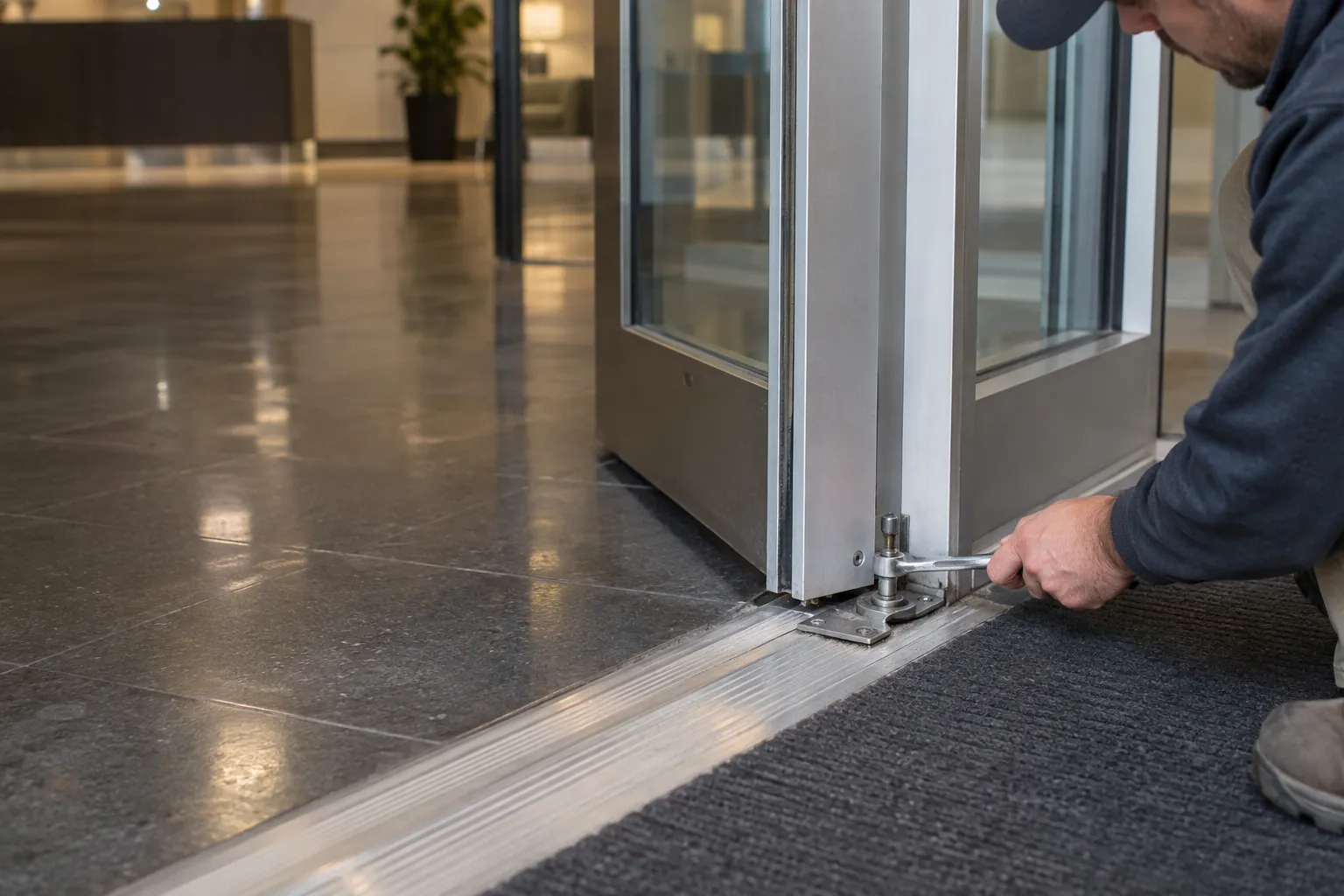
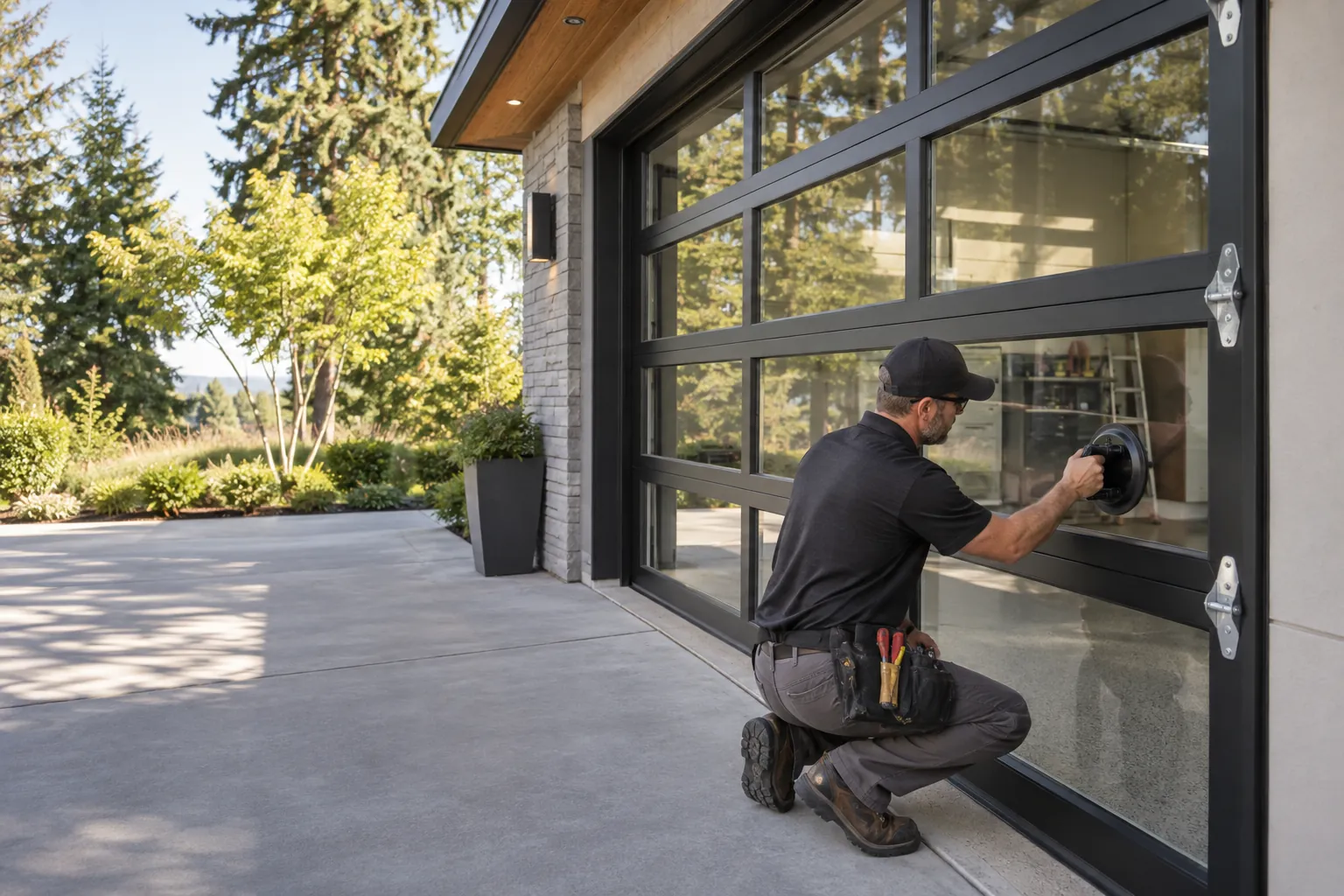
A technician checking a glass panel on an aluminum-and-glass garage door

Send the door, the label and the broken lite

One photograph of the whole door from outside, one of the manufacturer plate on the inside of a section or on the track, and one of the damage. That tells us the section height, the lite size and the glazing make-up, which is everything we need to specify the panel and plan the visit.

Call (703) 470-7867

Ready for Glass Garage Door Service?

Upload photos for a free estimate, or call for same-day service. Bonded and insured across DC, Maryland and Virginia.