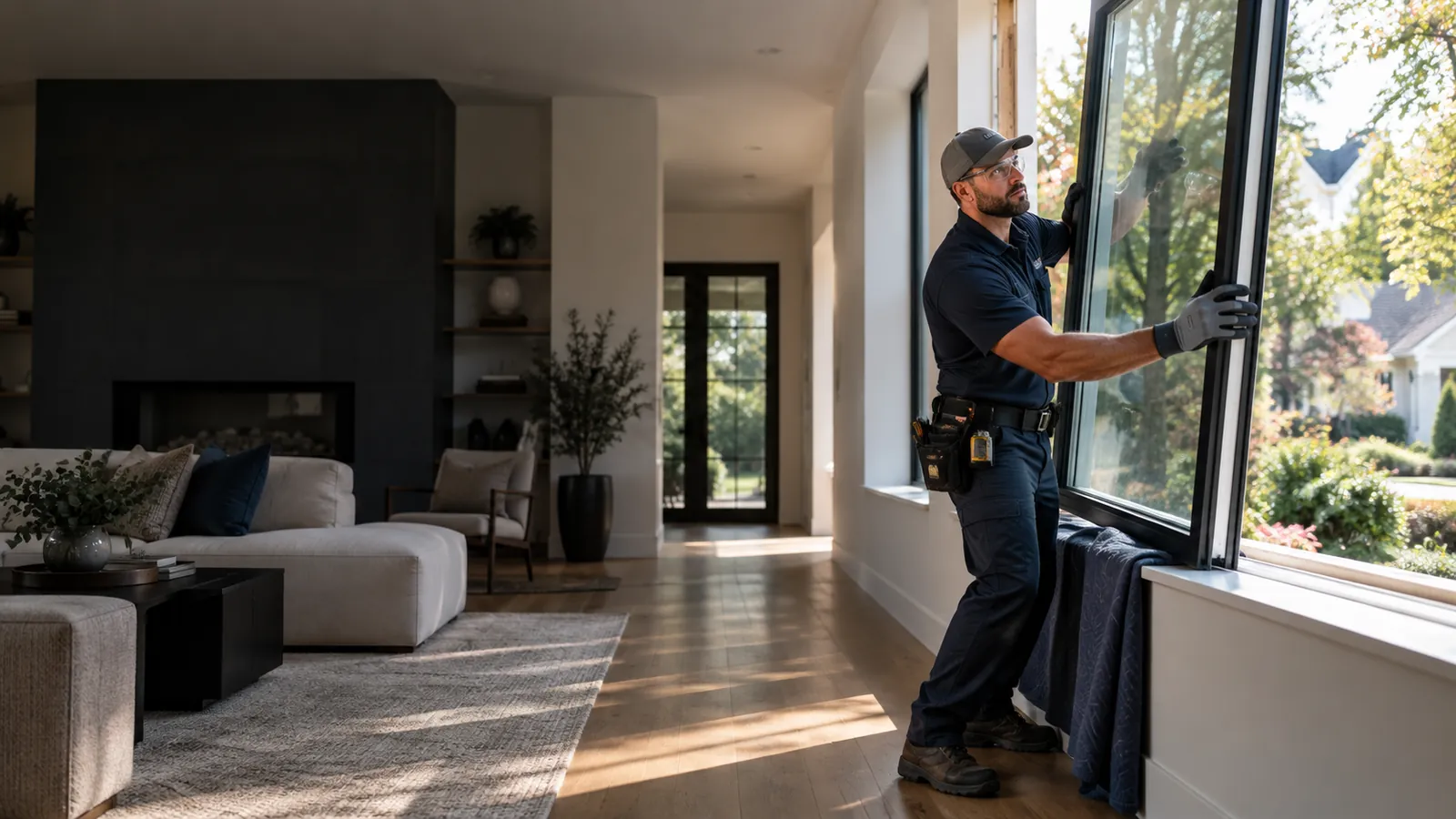
Window Balance Repair — When the Sash Will Not Stay Upin DC, MD & VA
The reason a double-hung sash falls shut is a spring device in the jamb called a balance, and almost nobody has heard of it until it breaks. We identify the type, length and weight rating in your window, replace them as a pair, and sort out the tilt latches, shoes and pivot bars that fail alongside them. Residential across DC, Maryland and Virginia.
- 24/7 Emergency Service
- DC · Maryland · Virginia
- Free photo estimates
Bonded & Insured
Residential and commercial
24/7 Emergency
Seven days a week
Free Estimates
No obligation
Locally Owned
Residential and commercial
Upfront Pricing
Never an overtime charge
24/7
Emergency dispatch
DC/MD/VA
All three jurisdictions
Matched
To your sash weight and travel
Same-Day
Service available
Why you need window balance repair now
Delaying repair doesn't save money — it multiplies the damage.
A Sash That Falls On Fingers
A failed balance turns a window into a guillotine. An insulated sash carries tens of pounds of glass before you count the frame, and it comes down at whatever speed gravity allows. In a house with small children this is the reason a broken balance gets fixed this week rather than next season.
A Bedroom Window That No Longer Provides Egress
Bedroom windows have to hold a minimum clear opening so someone can get out and a firefighter can get in. A sash that will not stay up does not provide it, no matter what the opening measures on paper. This is the one balance failure that is a code problem and not just an annoyance.
Propping It Open and Living With It
A stick, a book, a bottle of shampoo — every house with a failed balance has one. Beyond the obvious, a propped sash does not seal at the meeting rail, so the room loses conditioned air all summer and all winter, and the lock will not engage.
Being Told the Whole Window Needs Replacing
A failed balance is a hardware failure in a window whose frame, sash and glass are usually fine. Replacing balances is a fraction of the work of replacing the window and it restores the operation completely. There are windows worth replacing outright, and we will tell you when yours is one — but a dead balance on its own is not the reason.
Don't let it get worse
Window Balance Repair Benefits
Every service comes with our commitment to quality, speed, and transparency.
The Right Type, Length and Rating
Balances are matched to the sash weight and the travel. Fit one rated too light and the sash creeps down; too heavy and it walks up on its own. We identify what you have and match it.
Replaced in Pairs
When one balance goes the other is the same age and has done the same work. Replacing both keeps the sash square in the jamb, which is what stops it binding.
The Hardware Around It Too
Tilt latches, shoes, pivot bars, cam locks and keepers all fail alongside balances and all stop the window working properly. We carry the common ones and fit them at the same visit.
Weight-and-Pulley Sash As Well
Original double-hungs across older DMV neighbourhoods still run on cords and cast-iron weights. We re-cord them through the pocket rather than telling you the window is finished.
Tracks and Liners Cleaned and Squared
Half of the sticking windows we are called to are friction, not tension. If that is what yours is, we will say so and clean it rather than sell you parts you do not need.
Identified From Photos First
Tilt the sash in, photograph the balance and the channel, and we can usually name the part before anyone drives out.
Specified before it is ordered
Every window balance repair job starts with the assembly, not the pane. What the frame is, how the glass is captured, which code applies to that opening — those decide the specification, and the specification decides whether the repair lasts.
- Safety glazing specified to the code for the opening
- Same-day service for most jobs
- Free photo estimates with no obligation
- Bonded and insured, residential and commercial
Get a Free Window Balance Repair Estimate
Upload photos of the glass and we will come back with an itemized estimate. No home visit needed, no obligation.
Upload Photos NowHow Window Balance Repair Works
A simple, transparent process from first contact to completed job.
Photos or a Look
Tilt the sash in if it tilts, photograph the balance in the channel and the shoe at the bottom corner, and tell us what the sash does. That is usually enough to identify the part.
Diagnose Tension Against Friction
On site we run the sash through its travel. A window that is heavy everywhere is binding; a window that will not hold is a balance. The two get different work.
Pull the Sash and Read the Part
The sash comes out, the balance comes out of the channel, and the type, length and weight rating come off the part or off the sash weight.
Fit as a Pair
Both balances replaced, shoes squared in the channel, tilt latches and pivot bars checked and swapped where they are worn.
Run It and Hand It Back
Sash raised, lowered and stopped at several heights, tilt tested both sides, lock engaged, tracks cleaned. It should stop wherever you leave it and lock without lifting.
Before & After Window Balance Repair
Before
Damaged, inefficient glass compromising safety and comfort.
After
Crystal-clear, professionally installed glass restoring beauty and performance.
Signs You Need Window Balance Repair
What a Window Balance Actually Is
A double-hung window has two sashes that slide vertically past each other. Nothing about that arrangement holds a sash up on its own — the sash weighs what it weighs, and gravity is constant. The device that carries it is called a balance, and there is one in a channel in each jamb, hidden behind the jamb liner. It stores spring force and releases it as the sash travels, so the sash feels weightless in your hand at any height and stays where you leave it. It is the single most-used mechanical part in the window and the one nobody knows the name of.
Before Balances, There Were Weights
For most of the history of the double-hung window the counterweight was literal: a cast-iron weight on a cord, running over a pulley at the top of the jamb into a hollow pocket beside the window. Pull the sash up and the weight goes down; the two balance exactly, which is where the name comes from. Plenty of houses in Capitol Hill, Old Town Alexandria and the older parts of Bethesda and Silver Spring still have them, and they are worth keeping — a re-corded weight sash runs beautifully. The reason they went away is that the weight pocket is a hollow cavity in your wall that cannot be insulated.
Spiral Balances
The most common balance in vinyl and aluminium double-hungs from the 1970s on. A thin metal tube is anchored at the head of the jamb channel, and inside it a torsion spring is wound around a rod with a spiral twist. The bottom tip attaches to the sash. As the sash goes down the rod is pulled out of the tube and forced to rotate by the spiral, winding the spring; as the sash goes up the spring unwinds and helps lift it. They are cheap, compact and adjustable — a spiral balance that has lost some tension can often be rewound with a tension tool and put back to work. What cannot be fixed is a rod that has snapped at the tip, which is the usual end of one.
Block-and-Tackle Balances
Found in most modern tilt double-hungs with a vinyl or clad-wood frame. A flat channel houses a coil spring, a cord and two small pulleys rigged exactly like a block and tackle, so a short, strong spring produces a long, gentle pull over the full travel of the sash. The bottom end carries a shoe that the sash pivot bar sits in — the same shoe that lets the sash tilt in. They are quiet and they last, but the cord is a wear item: it runs over the sheaves thousands of times and eventually frays and parts, usually with a snap you can hear, after which that side of the sash drops.
Constant Force Coil Balances
The newest of the four and increasingly standard on current vinyl tilt windows. A curled stainless steel ribbon is wound on a drum clipped into the jamb liner, and it behaves like a tape measure that is always trying to roll itself back up. The advantage over a torsion spring is in the name: the pull is the same at every point in the travel, so the sash feels identical at the bottom of the opening and at the top. They fail by fatigue — the ribbon cracks where it curls — or by the mounting clip tearing out of the liner. They are replaced rather than adjusted, and always as a pair.
Channel and Sash Spring Balances
The type you find in older aluminium and wood single- and double-hungs, and common through a lot of DMV housing stock built between the war and the 1980s. A long metal channel is screwed to the face of the jamb with a spring running inside it and a take-out clip near the top that holds the tension when the sash is removed. They are simple and repairable, but the springs relax with age, and when the take-out clip breaks the balance can release its tension all at once — which is the main reason to leave this one to somebody with the tool.
How the Failure Is Diagnosed
Almost all of it comes from watching the sash. Raise it a few inches and let go. If it falls straight down at the same rate on both sides, both balances have lost tension. If one corner drops and the sash cocks in the jamb and jams, one side has failed and the other is still working, and the sash is now racked. If the sash is heavy through the whole travel but stays put when released, the problem is friction — dirt, paint or a distorted liner — and no new balance will fix it. If it creeps down an inch or two and then stops, that is partial tension loss, and on a spiral balance it is often an adjustment rather than a replacement. Noise that repeats at the same point in the travel is usually a seized sheave or a rod fouling its tube.
Taking the Sash Out
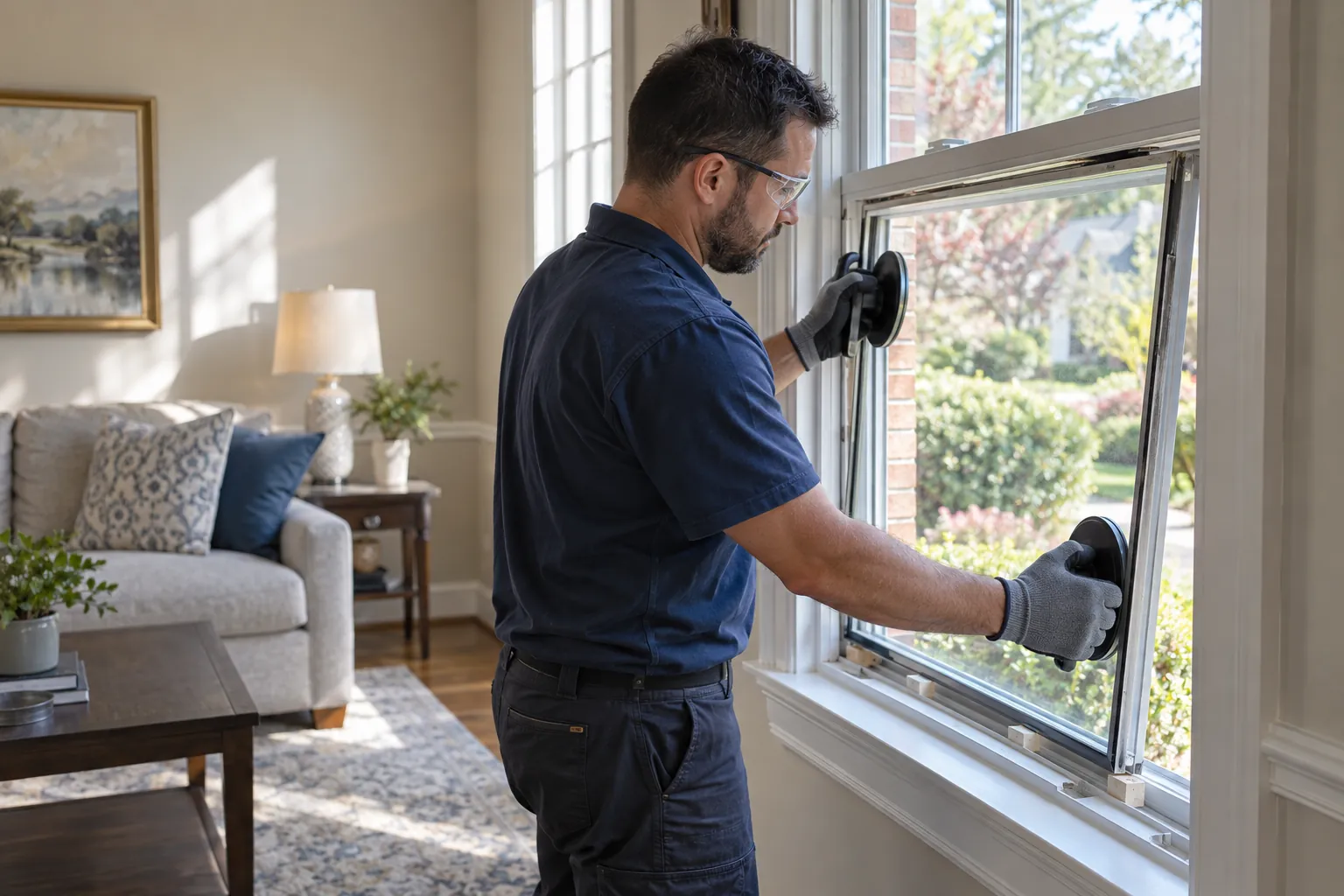
On a tilt double-hung the sequence is short: unlock, raise the lower sash four to six inches, slide both tilt latches inward, and tilt the top of the sash into the room until it is roughly horizontal. Lift one side so the pivot bar clears its shoe and the sash comes free. Reverse it to put it back, and if the shoes have spun in the channel while the sash was out they have to be turned square first or the pivot bars will not seat. On a fixed-jamb window there is no tilt, so the interior stop bead comes off and the sash comes forward out of the track. On a weight sash, the pocket cover in the lower jamb comes off to reach the weight. In all three cases the sash is heavier than it looks and wants two hands, and a balance still under tension wants respect.
Residential & Commercial Window Balance Repair

Residential Window Balance Repair
Professional service for homes, condos, and townhomes across the DMV.

Commercial Window Balance Repair
Serving offices, retail, restaurants, and buildings of any scale.
Window Balance Repair FAQ
Almost always a failed balance. A balance is a spring device hidden in a channel in each jamb that carries the weight of the sash so it stays wherever you put it. When the spring loses tension, the cord parts or the rod snaps, nothing is holding the sash and gravity takes it. Less often, the sash is simply binding on dirt, paint or a distorted jamb liner — but a window that binds is heavy in both directions, whereas a failed balance is easy to lift and refuses to stay.
Related Glass Services
Window Balance Repair Across the DMV
Work we stand behind
See the work, then judge it
Virginia Glass Windows is locally owned and has been doing residential and commercial glass across Northern Virginia, DC and Maryland for over a decade. Bonded and insured, on call around the clock.
The part that makes a sash stay up
A double-hung sash is not held by friction and it is not held by the lock. A spring device called a balance sits in a channel in each jamb, carrying the sash weight so the window stops wherever you leave it. When one fails, the sash falls — and almost nobody knows the part exists until that happens.
One balance per side, working as a pair, anchored at the head and running the full height of the channel. The lower end connects to a shoe, and the pivot bar on the bottom corner of the sash sits in that shoe — which is also what lets the sash tilt in for cleaning. The balance carries the sash weight over the whole of that travel, which is why the sash stops wherever you leave it.
A spring standing in for a counterweight
For a century the answer to holding a sash up was a cast-iron weight on a cord, running over a pulley into a hollow pocket beside the jamb. It worked, and in a lot of older houses across Capitol Hill, Old Town and the older parts of Bethesda it is still what is in the wall. It also needs a pocket, and a pocket is a hole in your insulation.
Everything built since roughly the 1970s uses a spring instead. A balance stores enough force to offset the sash and releases it as the sash travels, so the window is weightless in your hand at any height. That is the whole job, and it is why the failure is so recognisable: the moment the spring stops doing it, gravity takes the sash.
It is not a light part to have fall. A 32 by 30 inch insulated sash carries roughly 43 lb of glass in 1/4 inch lites before you count the frame. A sash that drops onto fingers on a sill does real damage, which is why a failed balance on a window children use is not a job to sit on.
Which one is in your window
They are not interchangeable. Identifying the type, then the length and the weight rating, is most of the work — the fitting is the easy part.
Spiral (tube) balance
Vinyl and aluminium double-hungs, 1970s onward
A thin metal tube in the jamb with a twisted rod running down inside it and a hex or hook tip at the bottom.
How it fails. The spring inside loses tension or the rod snaps at the tip. Retensioning buys time; a broken rod does not come back.
Block-and-tackle balance
Vinyl and clad-wood tilt double-hungs
A flat channel holding a coil spring, a cord and two small pulleys — the same trick as a block and tackle on a boat.
How it fails. The cord frays and parts over a pulley, or the spring lets go. The sash then drops or hangs on one side.
Constant force coil
Modern tilt sash, especially newer vinyl
A curled stainless ribbon on a drum, clipped into the jamb liner. It looks like a tape measure that never retracts fully.
How it fails. The ribbon fatigues and cracks at the curl, or the mounting clip pulls out of the liner. Usually replaced as a pair.
Channel (sash spring) balance
Older aluminium and wood single- and double-hungs
A long metal channel screwed to the jamb with a spring inside it and a take-out clip near the top.
How it fails. The spring relaxes or the take-out clip breaks. Common in older DMV housing stock and often the whole channel is replaced.
How a broken balance is diagnosed
How the sash misbehaves tells you which side failed and, usually, what failed. You can run most of these checks yourself in about a minute.
| What it does | Likely cause | The check |
|---|---|---|
| The sash slams shut the moment you let go | Both balances have lost tension, or both have failed. On a spiral balance the spring has unwound; on block-and-tackle the cords have parted. | Raise the sash a few inches and let go. If it falls at the same rate on both sides, both balances are gone rather than one. |
| The sash drops on one side and jams at an angle | One balance has failed and the other is still working, so the sash racks in the jamb and binds. | Look along the meeting rail. If it is no longer parallel with the frame, one side has let go. |
| The sash is heavy to lift and stays wherever you put it | Balance tension is high or the sash is binding on dirt, paint or a distorted jamb liner rather than being carried. | Clean the tracks first. A window that is stiff over its whole travel is usually friction, not balance. |
| The sash creeps down an inch or two, then stops | Partial loss of tension. Common on spiral balances, which can often be retensioned rather than replaced. | Note how far it drifts. Under a couple of inches is usually a tension adjustment; more than that is a replacement. |
| The sash will not tilt in, or tilts unevenly | A broken tilt latch, or a pivot bar that has come out of the shoe on one side and is now sitting in the channel. | Look at both bottom corners with the sash raised a few inches. A shoe out of position is visible from inside. |
| A grinding or clicking noise as the sash runs | A spiral rod fouling the tube, a sheave seized on a block-and-tackle unit, or debris in the channel. | Run the sash slowly and listen for where in the travel the noise happens. It usually repeats at the same height. |
| Rope and a weight behind the trim | Not a balance at all. This is an original weight-and-pulley sash, and the cord has parted inside the weight pocket. | Look for a small pulley in the upper jamb and a pocket cover low down. Common in pre-war DMV housing stock. |
| The window will not stay open far enough to climb out | A failed balance on a bedroom window is an egress problem as well as an annoyance. | If a bedroom window will not hold its clear opening, treat it as urgent rather than cosmetic. |
A balance under tension is stored energy
A charged spiral or constant-force balance released without being wound down can whip out of the channel. Take-out clips and tension tools exist for a reason. If you are prepared to pull a sash, do it with the balance de-tensioned and with both hands free — and stop if a balance is holding load you cannot control.
The sash comes out first
On a tilt double-hung the sash comes out in about thirty seconds once you know the sequence. On a fixed-jamb or an older channel-balance window it does not, and the stop bead has to come off instead.
Reversed to put it back: pivot bars into both shoes, tilt the sash upright until the latches click, then lower it. If the shoes have spun in the channel while the sash was out, they have to be turned back square first or the pivot bars will not seat.
Tilt sash
Latches in the top rail, pivot bars into shoes in the jamb liner. Out in seconds, back in almost as fast.
Fixed jamb
No tilt. The interior stop bead comes off so the sash can come forward out of the track, then the balance is unhooked.
Weight and pulley
The original system. The sash comes out, the pocket cover comes off, and the cord is re-run over the pulley to the weight.
Virginia
Virginia Uniform Statewide Building Code (2021 IRC/IBC with amendments)
VA enforces the USBC statewide, so Arlington, Fairfax and Loudoun read from the same book. Local plan review still varies.
Maryland
Maryland Building Performance Standards (2021 IBC/IRC) plus county amendments
Montgomery and Prince George’s counties add amendments. Montgomery is the stricter of the two on guard glazing.
Washington, DC
DC Construction Codes (2017 base, 2021 update cycle) with DC supplements
DC adds historic-district review on any street-facing change. Expect DCRA review time on storefront work.
Hardware repair is maintenance and does not normally involve a permit. The codes matter here for one reason: a bedroom window has a minimum clear opening for escape, and a sash that will not stay open does not provide it.
Send a photo of the sash and the jamb channel
With the sash tilted in we can usually identify the balance type, the length and the weight rating from pictures alone. DC, Northern Virginia and the Maryland suburbs.
Explore More Resources
Common Problems
Our Services
Ready for Window Balance Repair?
Upload photos for a free estimate, or call for same-day service. Bonded and insured across DC, Maryland and Virginia.