Glass Specifications for Passive House Construction in the DMV
Passive house construction in the DMV requires glass specifications dramatically more demanding than standard residential practice. Understanding the performance targets — U-values, SHGC, thermal bridge-free framing — is essential for architects, builders, and homeowners pursuing this standard.
Mike Reynolds
Lead Glass Technician & Owner
In This Article
What Passive House Demands of Glass
The Passive House (Passivhaus) standard is the most rigorous residential energy performance framework in use today. A certified Passive House in the DMV climate must achieve a specific heating demand ceiling, a cooling demand ceiling, and total primary energy consumption limits that are typically 70 to 90 percent below standard construction. Windows are the critical variable in achieving these targets — they are simultaneously the largest thermal weakness in the building envelope and the primary source of solar heat gain that Passive House design strategically uses in winter to offset heating demand.
The glass specification for a Passive House is not an incremental improvement on standard residential glass — it is a fundamentally different performance tier. Where a standard DMV home might use double-pane Low-E argon glass with a window U-factor (including the frame) of 0.28 to 0.35, a Passive House typically requires a whole-window U-factor of 0.14 to 0.20. Achieving that performance level requires triple-pane glass as a minimum, combined with high-performance spacer systems, thermally broken frames with very low conductance, and careful attention to the installation interface between the window unit and the wall assembly.
The DMV climate creates specific challenges for Passive House glass specification because it is a mixed heating-and-cooling climate — the same glass specification that maximizes winter solar gain and minimizes winter heat loss may not be optimal for managing summer overheating. The Passive House designer must balance these competing demands through glass placement, orientation-specific glass selection, and often external shading for south and west-facing glazing.
Triple-Pane Glass: The Passive House Baseline
Triple-pane insulated glass units — three panes of glass with two sealed gas-filled cavities — are the baseline glazing specification for Passive House construction in the DMV climate. A quality triple-pane unit with two Low-E coatings and krypton or argon fill in both cavities can achieve center-of-glass U-values of 0.08 to 0.12, compared to 0.20 to 0.28 for double-pane Low-E argon. This difference is large enough to affect the fundamental feasibility of meeting Passive House heating demand targets — with double-pane glass, many DMV Passive House designs cannot meet the certification thresholds regardless of how well the rest of the envelope performs.
The gas fill choice in triple-pane units for Passive House applications is typically krypton rather than argon for at least one of the two cavities. Krypton's lower thermal conductivity provides better performance in the narrower cavity widths used in triple-pane units to limit overall glass thickness. A triple-pane unit with two krypton-filled 8mm cavities outperforms the same unit with argon fill, particularly at the center-of-glass where conductive and convective heat transfer through the cavity gas dominates thermal performance.
Low-E coating placement in a triple-pane unit matters. The most common configuration places Low-E coatings on surfaces 2 and 5 (the inner faces of the outer and inner panes) to intercept radiation from both directions. For DMV Passive House projects with south-facing glazing designed to admit winter solar gain, a passive (higher SHGC) coating specification may be appropriate on those elevations, while solar control coatings are specified on west-facing glazing where summer overheating risk is higher.
Spacer Systems and Thermal Bridging
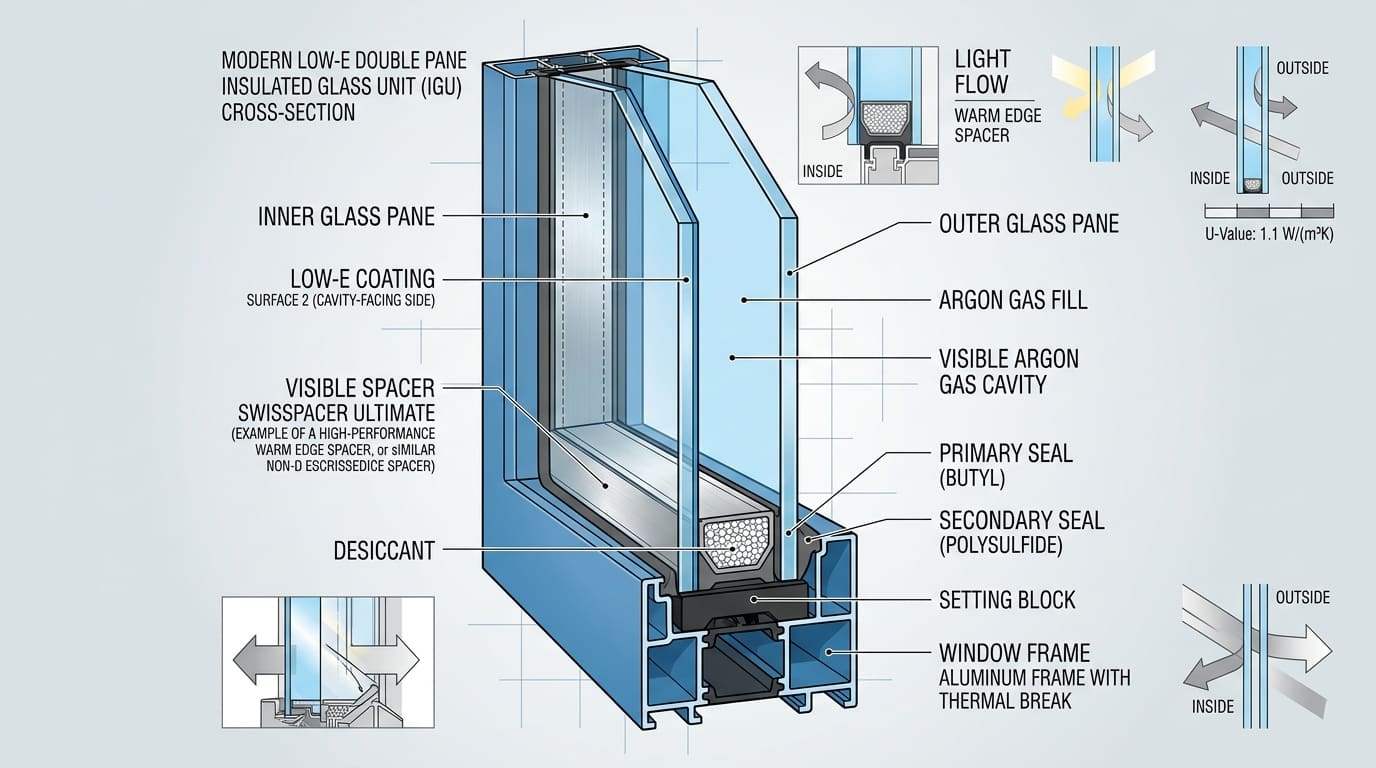
In a triple-pane unit designed for high thermal performance, the spacer system connecting the glass panes at the perimeter is a critical component that is often underspecified. Aluminum spacers, widely used in standard IGU construction, are highly conductive — they create a significant thermal bridge at the glass edge that reduces the actual installed thermal performance below the center-of-glass value. In a standard residential window, this edge effect is a modest concern. In a Passive House context, where total thermal performance must be calculated precisely to confirm certification, the edge thermal bridge from an aluminum spacer can be the difference between meeting and missing the certification target.
Warm-edge spacer systems — made from structural foam, thermoplastic materials, or stainless steel — reduce the spacer conductance and the resulting edge thermal bridge by 30 to 70 percent compared to aluminum. For Passive House projects, warm-edge spacers in triple-pane units are essentially a non-negotiable specification. The performance models used for Passive House certification (typically the PHPP software) account for the spacer thermal bridge specifically, and warm-edge spacers produce certified performance values substantially closer to the center-of-glass performance.
Frame Performance: The Often-Neglected Component
The whole-window U-factor — the metric that actually matters for Passive House certification — incorporates not just the glass center-of-glass value but also the frame conductance and the glass-edge thermal bridge. A triple-pane glass unit with U-value of 0.10 installed in a standard vinyl frame with U-value of 0.30 produces a whole-window U-value of 0.18 to 0.22 — meaningfully higher than the glass-only performance and potentially outside the Passive House target range depending on the design.
Certified Passive House windows use highly thermally broken frames with U-values of 0.14 to 0.20 or lower. These frames are typically European imports or North American products specifically designed for the Passive House market: multi-chamber PVC frames with high thermal mass, structural foam-filled fiberglass frames, or solid wood frames with exterior insulating cladding. These frame systems cost significantly more than standard residential window frames but are required to achieve the whole-window performance that Passive House demands.
For DMV projects where the architectural preference is for a minimal-sightline window — common in contemporary Passive House designs — European aluminum-clad wood frames from manufacturers like Schuco, Internorm, or Optiwin provide both the thermal performance and the aesthetic characteristics of a slim, contemporary window profile. These are premium products at premium prices, but they are appropriate tools for a project where the performance specifications require them.
Installation: The Thermal Bridge-Free Interface
Even perfect glass specification and frame selection fails to deliver its potential if the window is installed in a way that creates thermal bridges between the frame and the wall assembly. Passive House window installation requires positioning the window unit in the wall opening at the plane of the continuous insulation, sealing the installation joint with vapor-permeable tape systems on the exterior and vapor-retarding tape systems on the interior, and ensuring that the structural fastening does not create point thermal bridges through the insulation layer.
This level of installation detail is beyond standard residential window installation practice and requires either specialized training or supervision by a Passive House consultant. For DMV architects and builders pursuing Passive House certification, the glass supply and installation must be coordinated with a glass contractor familiar with Passive House requirements. Virginia Glass Windows works with passive house builders and energy consultants throughout the region on glass specification and installation projects. Contact us at (703) 470-7867 to discuss your project requirements — our experience with high-performance glass specifications for custom residential construction in the DMV is directly relevant to passive house and ultra-efficient building projects.
About the Author
Mike Reynolds
Lead Glass Technician & Owner
With over 15 years of experience in window and glass repair across the DC, Maryland, and Virginia area, Mike shares practical expertise to help homeowners and businesses make informed decisions about their glass repair and replacement needs.
Need Help With Your Glass?
Our experts are ready to help with any window or glass issue. Free estimates, same-day service available across DC, MD & VA.
Related Articles
Continue reading about energy efficiency
 Energy Efficiency
Energy-Efficient Glass Upgrades for DMV Homes: Low-E, Argon & Beyond
Energy EfficiencyArgon vs Krypton Gas in Windows: Performance & Cost Comparison
 Energy Efficiency
NFRC Window Ratings Explained: What the Numbers Actually Mean for Your DMV Home
More Energy Efficiency
View AllEnergy-Efficient Glass Upgrades for DMV Homes: Low-E, Argon & Beyond
10 min read
Low-E Glass Explained: Is It Worth the Upgrade for Your DMV Home?
7 min read
When to Upgrade from Single-Pane to Double-Pane Windows in the DMV
8 min readHow Glass Replacement Saves Money on Energy Bills in the DMV
7 min readExplore More Resources
Helpful Guides
Common Problems
Related Pages
Our Services
24/7 Emergency
Board-Up & Glass
Licensed & Insured
DC, MD & VA
300+ Areas
DMV Coverage
Same-Day Service
When You Need It
Ready to Get Started?
Get a free estimate for any window or glass service across the DMV area.