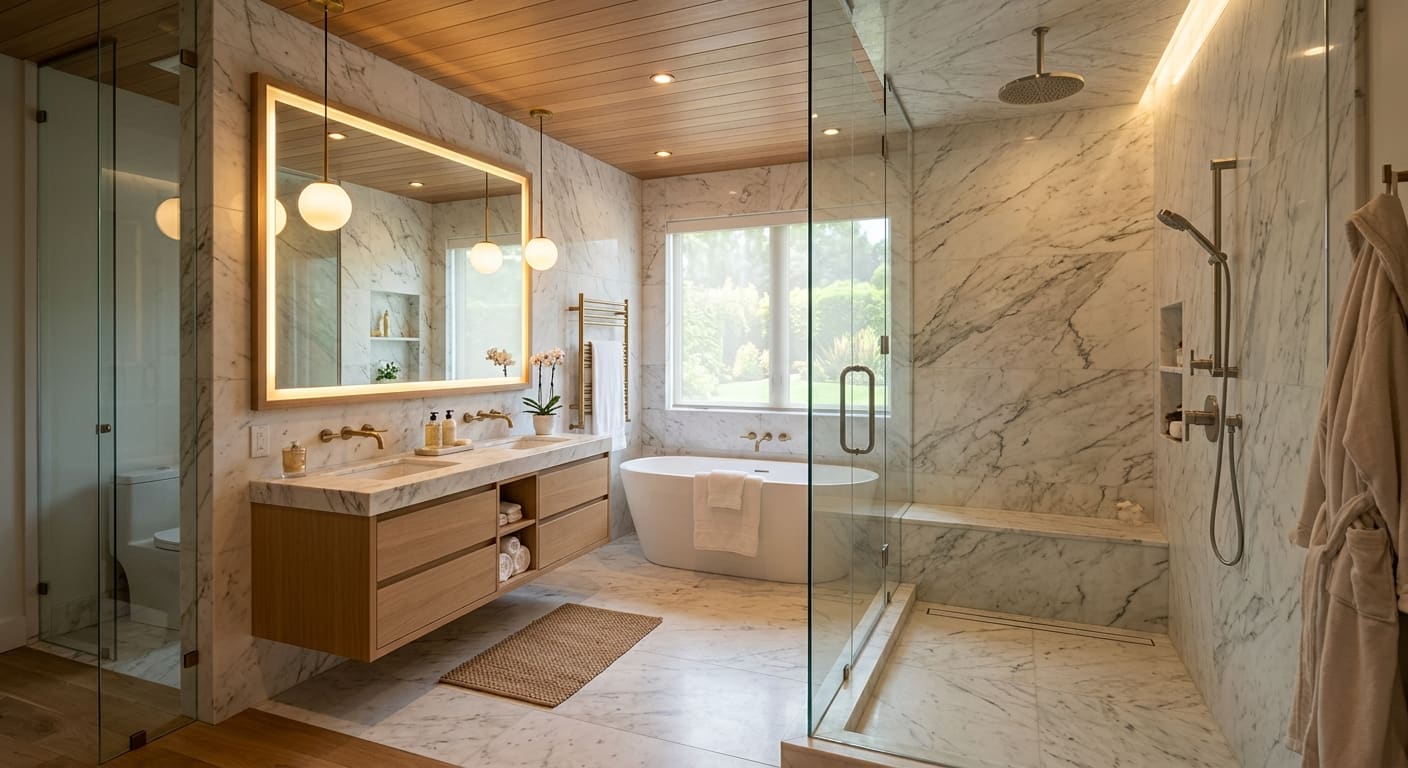
Bathroom Glass Trends for 2026: Walk-In Showers, Partitions, and Vanity Mirrors in DMV Homes
The bathroom is where glass design investment pays back the most visibly in a 2026 remodel. Here is what DMV homeowners are actually doing — from walk-in showers to full-wall mirrors — and what the right specifications are.
Mike Reynolds
Lead Glass Technician & Owner
In This Article
Why the Bathroom Is Where Glass Investment Shows Most
Of all the rooms in a house where glass choices are made, the primary bathroom pays back those choices most visibly and consistently. A well-designed frameless shower enclosure in quality glass transforms the visual scale of the room — making a standard bath feel dramatically larger and more intentional. A poorly chosen frameless enclosure with the wrong glass thickness, the wrong hardware finish, or the wrong structural approach creates a space that feels cheap regardless of how much was spent on the tile and fixtures. In twenty years of bathroom glass work in the DMV market, I have seen both outcomes, and the difference almost always traces back to a few fundamental specification decisions made before the glass was ordered.
The 2026 bathroom glass landscape in the DC metro area reflects broader renovation trends: frameless heavy-glass enclosures have moved from luxury to expected standard in primary bath renovations above a certain price point. Full-width vanity mirrors spanning wall to wall have largely replaced the frameless medicine cabinet and the small decorative mirror. Glass partition walls between the toilet room and the main bath are showing up in master bath renovations in Bethesda, McLean, and upper Northwest DC where the master bath footprint supports them. And specialty glass — reeded, fluted, frosted with custom patterns, ultra-clear low-iron — is showing up in bathrooms where ten years ago it was exclusively in showrooms.
Frameless Shower Enclosures: Thickness, Hardware, and Configuration
The glass thickness question in frameless shower enclosures is one where there is a right answer and a cost-driven wrong answer. The industry minimum for frameless shower glass is 3/8 inch, and this is what lower-end enclosures use. The right specification for a primary bath frameless enclosure in a DMV home renovation is 1/2 inch. The difference is significant: 1/2-inch glass is substantially heavier (about 33 percent heavier per square foot), noticeably more rigid, and projects a quality that is immediately perceptible when you touch or look at it. The edge visibility — when you see the glass edge at the door hinge point or at the glass-to-glass corner — is 50 percent thicker and has the visual mass of a premium product. In a renovation where tile, fixtures, and plumbing represent a significant investment, specifying 3/8-inch glass to save cost on the enclosure is a visible compromise that undermines the overall quality of the room.
Hardware selection and finish coordination is the other critical decision, and it is one that needs to happen before glass ordering in a properly managed bathroom project. Door handles, hinges, support bars, and wall channels come in multiple finish options — brushed nickel, polished chrome, matte black, brushed gold, and variations thereof — and the enclosure hardware needs to be selected to coordinate with faucets, shower heads, and towel bars. This sounds obvious, but in practice it is one of the most common bathroom renovation coordination failures we see. The glass can be on site and ready to install with hardware that does not match anything else in the room because the decision was deferred. We require hardware selection before we order glass for any frameless enclosure project.
The structural configuration — frameless panels, frameless door in semi-frameless channel, full frameless corner enclosures — depends on the shower footprint and the structural context. Walk-in showers without doors (using a return wall or angled entry to contain water) are strongly trending in the DMV market for larger primary baths; they eliminate the maintenance of a door and seals and create the most visually open appearance. For bathrooms with smaller footprints, a frameless hinged door with a stationary panel is the standard. Corner entry configurations with two glass panels and an angled door work well in square shower footprints. We design the configuration based on your specific dimensions — call (703) 470-7867 to schedule a measurement consultation.
Specialty Glass in Bathrooms: Reeded, Fluted, Ultra-Clear
The textured glass trend that has been visible in interior design for the past several years has hit the bathroom space in the DMV market. Reeded glass — vertical parallel ridges that create a ribbed surface — and fluted glass (similar profile with wider spacing) are appearing in shower partitions, shower door panels, and frameless shower walls in bathrooms where the design intent is to add visual interest while maintaining privacy. The reeded shower wall or partition reads as a deliberate design element that coordinates with the ribbed texture of fluted tile, rattan accessories, and the organic material palette that is broadly trending in interior design right now.
The practical consideration with reeded and fluted glass in shower enclosures is maintenance. The ridges create more surface area and more angles than flat glass, which means more places for water deposits and soap scum to accumulate. In a hard-water area like parts of suburban Maryland and Northern Virginia, the cleaning requirement for textured shower glass is more intensive than for smooth glass. If you are drawn to the aesthetic of reeded glass for a shower enclosure, plan your cleaning routine around it — and consider specifying a hydrophobic protective coating applied to the textured surface at installation to reduce deposit adhesion. We apply these coatings to all new shower glass on request, and they meaningfully reduce the cleaning burden on textured surfaces.
Ultra-clear low-iron glass — the greenless, colorlessly transparent glass described in other articles — is a worthwhile upgrade for frameless shower enclosures specifically. In the bright conditions of a lit shower with white or light tile, the greenish tint of standard glass becomes perceptible as a cast on the tile color. Low-iron glass makes the tile look as it was intended — the color the designer chose is the color you see, without the subtle green overlay that standard glass imposes. For bathrooms with warm stone tile, white subway tile, or any tile where color accuracy matters, the low-iron upgrade on the shower glass is an investment in showing off the tile you spent money on.
Full-Width Vanity Mirrors: Sizing, Mounting, and Lighting Integration
The full-width vanity mirror — spanning the entire width of the vanity or the vanity wall — has become the dominant choice in primary bath renovations in the DMV for good practical and aesthetic reasons. It maximizes light reflection in the room, making the space feel larger and brighter. It eliminates the awkward sizing decisions around standard rectangular mirrors. And it creates a clean architectural line that coordinates with the horizontal emphasis of contemporary bathroom design. For double-vanity bathrooms, a full-width mirror spanning both sinks eliminates the awkward center gap between two separate mirrors that often ends up being exactly the wrong width and height for the architecture.
The practical questions are glass thickness and mounting. Bathroom mirrors up to approximately 24 inches by 48 inches can be mounted in standard mirror clips without backing support. Larger mirrors — the 60-inch or 72-inch full-width mirrors common in double-vanity baths — should be mounted on a full backing panel or with a continuous French cleat mount rather than edge clips. The weight of large mirrors is significant, and the risk of a clip failure in a bathroom — where humidity and vibration from doors and drawers are constant — is not worth taking with an inadequately supported piece of glass. We mount all large vanity mirrors with backing support as a standard practice.
Lighting integration — backlit mirrors, vertically lit frames, combination mirror-medicine cabinet — is a related decision that needs to happen alongside mirror sizing and mounting. Backlit mirrors require rough-in electrical at the mirror location before the mirror is installed. If you are planning a backlit or lighted mirror and your bathroom rough-in did not include an outlet or switch leg at that location, coordinate with your electrician before we install the mirror. The DMV area is full of bathroom renovations where the beautiful mirror arrived and the electrical rough-in was in the wrong place — a coordination failure that costs time and money to resolve after the fact.
Ventilation, Moisture, and Glass Longevity in Bathroom Applications
The highest-stress glass environment in a home is the bathroom, and the main stressor is moisture cycling. Shower glass that goes from dry to steam-saturated to dry multiple times per day experiences thermal and humidity cycling that degrades seals, grows mineral deposits, and can contribute to the delamination of mirror backing over time. Adequate bathroom ventilation is not a separate subject from glass longevity — it is directly related. A bathroom with inadequate exhaust ventilation traps steam that then deposits on all glass surfaces, accelerates mineral buildup on shower glass, and creates the humidity conditions that degrade mirror backing over years. If you are investing in bathroom glass, invest in proper ventilation as part of the same project. The glass work we do at Virginia Glass Windows includes a consultation on cleaning and maintenance at installation — the small effort of proper daily wiping and periodic deep cleaning of shower glass is what makes a frameless enclosure look as good at ten years as it did the week it was installed.
About the Author
Mike Reynolds
Lead Glass Technician & Owner
With over 15 years of experience in window and glass repair across the DC, Maryland, and Virginia area, Mike shares practical expertise to help homeowners and businesses make informed decisions about their glass repair and replacement needs.
Need Help With Your Glass?
Our experts are ready to help with any window or glass issue. Free estimates, same-day service available across DC, MD & VA.
More Guides
View All
How to Tell If Your Window Glass Needs Repair or Replacement
8 min read
Stress Cracks in Windows: Causes, Prevention & Solutions for DMV Homeowners
7 min read
Foggy Windows: Why Double-Pane Seals Fail & What to Do About It
9 min read
Glass Replacement in Historic DMV Homes: Preservation Meets Performance
9 min readExplore More Resources
Common Problems
Related Pages
Our Services
24/7 Emergency
Board-Up & Glass
Licensed & Insured
DC, MD & VA
300+ Areas
DMV Coverage
Same-Day Service
When You Need It
Ready to Get Started?
Get a free estimate for any window or glass service across the DMV area.