2026 Glass Trends Shaping DMV Homes: Smart Glass, Ultra-Clear, Oversized Panes, and More
We install glass in hundreds of DMV homes every year. Here is what clients are actually asking for and installing in 2026 — not what the design magazines are theorizing about, but what is going in the ground.
Mike Reynolds
Lead Glass Technician & Owner
In This Article
What We Are Actually Seeing on the Ground
Every year around this time I get asked some version of the same question by real estate agents, interior designers, and homeowners who are planning renovations: "What are people doing with glass right now?" It is a good question and I want to answer it honestly, from the standpoint of someone who is in DMV homes every day doing this work, rather than curating a list of theoretical trends from design publications that may or may not reflect what is actually happening in the Bethesda or Alexandria market.
The honest answer in 2026 is that the gap between aspirational glass design and what most DMV homeowners are actually installing has narrowed considerably. Smart glass, which five years ago was a novelty that we quoted a couple of times a year, is now a regular conversation that turns into a regular installation. Ultra-clear low-iron glass, which was exclusively a high-end custom project material, is being specified on mid-range shower enclosures because the price premium has shrunk enough to make it a routine upgrade decision. These are not trends in the sense of what is fashionable — they are trends in the sense of what has crossed the adoption threshold and is showing up in ordinary renovation budgets.
What follows is what we are actually installing and quoting in the first quarter of 2026, filtered through the specific character of the DMV housing market — which has its own distinct profile of renovation investment, real estate dynamics, and housing stock characteristics that shapes what glass trends actually land here versus the ones that remain coastal California or NYC phenomena.
Smart Glass in Residential Bathrooms and Home Offices
PDLC switchable smart glass has crossed a meaningful adoption threshold in the DMV market. We are quoting and installing it in primary bathroom shower enclosures, home office interior partitions, and master bedroom privacy windows at a rate that would have been remarkable two years ago. The driver is not primarily cost — smart glass is still a premium product — but rather the convergence of better product quality, faster installation times (our installation crews are now experienced with the product rather than learning on the job), and growing consumer familiarity from seeing it in commercial settings like hospitality and medical office environments.
The applications we are seeing most frequently: frameless shower enclosures in primary bath renovations in McLean, Bethesda, and upper Northwest DC, where the design goal is a clean open-plan look that can switch to full privacy; home office glass walls separating the office from an adjacent living space, allowing the office to feel open when not in use and clearly private during calls; and master bedroom windows in homes where the bedroom looks out onto a pool deck or courtyard where the interior view needs to be controllable. In all of these applications, the key feature is not just privacy on demand but the ability to have full clear glass as the default state, which standard frosted or textured glass cannot provide.
One pattern we notice in the DMV specifically: smart glass adoption is concentrated in homes with relatively deep renovation investment, typically $100K or more in combined project scope. At that level, smart glass for a shower enclosure or a home office wall represents a modest incremental cost relative to the overall project. The DMV's concentration of high-income households in professional occupations — federal contractors, law firms, tech companies, lobbying and consulting — supports a buyer profile that is receptive to technology integration in the home environment. This is not a coincidence of design preference; it reflects the economic character of the market.
Ultra-Clear Low-Iron Glass Goes Mainstream
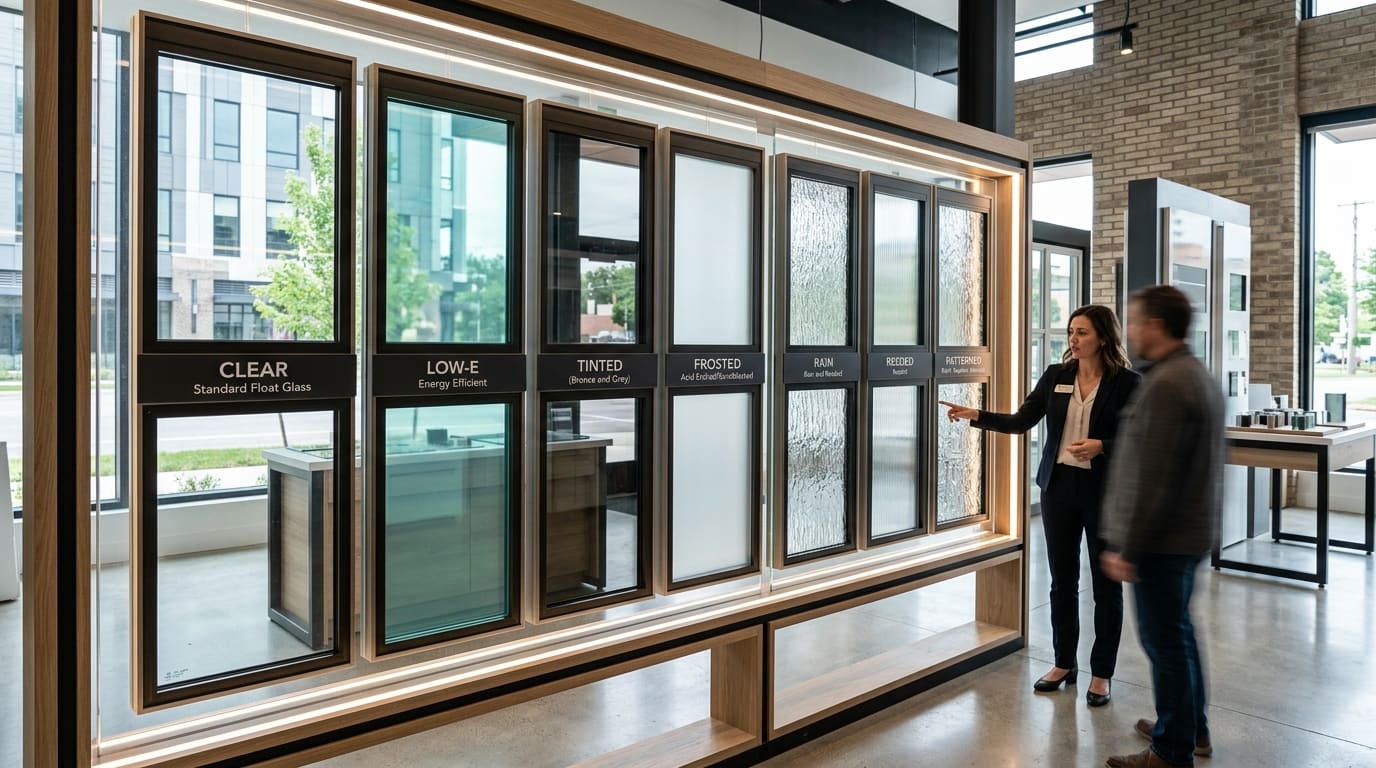
The visual difference between standard clear glass and low-iron ultra-clear glass is immediately obvious when the two are placed side by side. Standard glass has a distinctly green edge — visible when you look at the glass from the side — and imparts a slight green cast to whatever is viewed through it. Low-iron glass (sold under brand names including Starphire, Optiwhite, and Diamant) has a neutral, colorless clarity that makes glass disappear visually rather than announcing itself. For most of glass history this was a specification only in high-end commercial and institutional glazing, where budgets supported the premium and the application demanded perfect color neutrality.
What is changing in 2026 is where the price of low-iron glass has landed. The premium over standard clear has compressed to the point where it is a routine upgrade decision on shower enclosures, glass railings, and frameless glass doors rather than a special-order luxury item. On a frameless shower enclosure, the upcharge for low-iron glass over standard clear is typically in the range of 15 to 25 percent — meaningful but not deal-breaking for a bathroom renovation that is already a significant investment. And the visual improvement is disproportionate to the cost: the clean, colorless transparency of low-iron glass makes the shower space feel brighter and more open in a way that is visible every day.
The DMV applications where we are specifying low-iron glass most frequently in 2026: frameless 3/8-inch and 1/2-inch shower enclosures where the thick glass edge is prominently visible; glass deck and stair railings in Great Falls, McLean, and Chevy Chase single-family homes where the green edge of standard glass clashes with the landscape view; large interior glass sliding doors and partition walls where multiple panels are visible simultaneously; and custom glass tabletops where color neutrality is important for furniture styling. The category where we see the least uptake is standard double-pane window replacement, where the low-iron premium adds less visible value because the edges are hidden in the frame.
The Oversized Window Moment in DMV Architecture
The trajectory toward larger glass openings and thinner frames has been consistent for over a decade in residential architecture, and 2026 feels like a moment where it has become the dominant rather than exceptional aesthetic in high-end DMV new construction and renovation. The Tysons and Reston urban cores have seen significant new residential construction with floor-to-ceiling glass facades. McLean and Great Falls custom homes are routinely specifying lift-and-slide door systems ten to twelve feet wide. Even in the tighter constraints of DC rowhouse renovations, removing traditional divided-light windows and replacing them with large single-pane sashes or floor-level picture windows is a common renovation move that dramatically changes the character of the interior.
The practical implications for glass are significant. Larger panels are heavier and require more precise installation — a single oversized insulated glass panel can weigh two hundred to four hundred pounds depending on construction. Structural support in the wall framing must accommodate the increased load and the longer spans required for wide openings. Thermal performance must be maintained across the larger glass area, which typically requires specifying more aggressive Low-E coatings and considering triple-pane construction for very large north-facing openings. And the installation equipment — suction lifters, frame support systems, alignment tools — needs to match the scale of the work.
The design trend that is shaping this most directly in the DMV right now is the indoor-outdoor living aspiration — the desire to open an entire wall of the house to a deck, screened porch, or garden when the weather allows, and to have the space feel visually continuous even when the glass is closed. The DMV's climate (genuinely cold winters, hot humid summers, and about six weeks of perfect spring and fall weather on either end) creates a specific demand for glass systems that perform equally well fully closed in a January wind and fully open on a May evening. Multi-slide and lift-and-slide systems with narrow-profile thermally broken aluminum frames meet this demand better than anything that existed ten years ago. We are doing these installations regularly now throughout the DMV.
Black Frames and the Steel-Look Aesthetic
If I had to pick the single aesthetic trend that has had the most consistent impact across all price points in the DMV market over the past three years, it is the shift from white and beige window frames to black. It shows up everywhere — vinyl replacement windows in Fairfax County townhouses, aluminum windows in Silver Spring mid-rises, thermally broken aluminum in McLean custom homes, and actual hot-rolled steel in Georgetown and Capitol Hill renovations where the industrial heritage of the aesthetic is most architecturally appropriate.
The practical question is which black frame material actually makes sense for a given application. True steel windows are the premium option — they achieve the thinnest possible sightlines (sometimes under one inch) and have a material authenticity that aluminum cannot replicate, but they require more maintenance, have poorer thermal performance without thermal breaks, and cost significantly more than aluminum alternatives. They are the right choice for specific historic neighborhoods and high-end custom work where the authentic material is the point. For most DMV homeowners who want the black-frame look with better practical performance, thermally broken aluminum with a powder-coated black finish is the right specification — similar slim profiles, much better thermal performance, lower cost, and essentially no maintenance.
The trend toward black frames has a functional implication beyond aesthetics: black powder-coat and anodized black finishes on aluminum have proven more durable in the DMV climate than they were twenty years ago, when early black anodized aluminum frames were prone to chalking and fading in the UV exposure of the DMV summers. Modern powder-coat formulations and high-quality anodizing processes hold their color well for fifteen to twenty years of exposure, making black frames a reasonable long-term commitment rather than a maintenance burden. If you are considering window replacement or new construction with black frames, we are happy to talk through the material options and what the realistic maintenance picture looks like over time. Reach out at (703) 470-7867 for a free consultation.
About the Author
Mike Reynolds
Lead Glass Technician & Owner
With over 15 years of experience in window and glass repair across the DC, Maryland, and Virginia area, Mike shares practical expertise to help homeowners and businesses make informed decisions about their glass repair and replacement needs.
Need Help With Your Glass?
Our experts are ready to help with any window or glass issue. Free estimates, same-day service available across DC, MD & VA.
Related Articles
Continue reading about guides
More Guides
View All
How to Tell If Your Window Glass Needs Repair or Replacement
8 min read
Stress Cracks in Windows: Causes, Prevention & Solutions for DMV Homeowners
7 min read
Foggy Windows: Why Double-Pane Seals Fail & What to Do About It
9 min read
Glass Replacement in Historic DMV Homes: Preservation Meets Performance
9 min readExplore More Resources
Helpful Guides
Common Problems
Related Pages
Our Services
24/7 Emergency
Board-Up & Glass
Licensed & Insured
DC, MD & VA
300+ Areas
DMV Coverage
Same-Day Service
When You Need It
Ready to Get Started?
Get a free estimate for any window or glass service across the DMV area.