DIY Window Energy Audit: How to Assess Your Windows and Find DC/MD/VA Rebate Programs
Before you spend anything on window upgrades, do a proper assessment of what you actually have. Here is how to evaluate your windows systematically — and how to access DMV utility rebate money that many homeowners never claim.
Mike Reynolds
Lead Glass Technician & Owner
In This Article
Why Assessment Before Action Saves You Money
I have visited dozens of homes over the years where the homeowner was convinced they needed new windows — full replacement, the whole house, every window — based on a feeling of general discomfort, a high utility bill, or a conversation with a neighbor who had just done it. Then we do a systematic assessment and find that three windows out of eighteen have failed seals, the rest are performing fine, and the real problem is a gap at the attic hatch that was leaking conditioned air like a chimney. The window replacement would have spent twenty thousand dollars on something that was not the problem.
Window energy assessment is not complicated, and most of it is DIY-accessible with no tools beyond your hands and eyes and a candle or a stick of incense. What it requires is patience and systematic coverage — going window by window rather than just "checking the windows" as a general impression. The difference between a systematic and casual assessment is whether you catch the two or three windows in a twenty-window house that are causing most of the thermal loss, versus concluding generally that "the windows are fine" or "the windows are bad."
A professional energy audit by a BPI-certified auditor — which is required to access some of the incentive programs described later — will use a blower door test (which pressurizes the house to amplify infiltration) and an infrared camera (which visualizes temperature differentials) to identify exactly where the losses are. This is more accurate than a DIY assessment, but for most homeowners, the DIY approach identifies the obvious problems clearly and allows you to make smart decisions about where to invest before spending on a professional audit.
The Hands-and-Candle Method: Finding Air Infiltration
The most useful and immediate assessment technique requires nothing more than a slow walk around your house on a cold day with your bare hand. On a day when the outside temperature is below 35 degrees (a regular occurrence in the DMV from December through February), hold your palm one to two inches from the glass surface and then move slowly around the perimeter of the frame — along the sill, up both sides, and across the top. Areas of air infiltration feel distinctly cooler than the glass surface itself, and at known infiltration points the flow is often detectable as actual movement of air against your palm.
Pay particular attention to the corners of the window frame — both the exterior corners where the frame meets the wall and the interior corners where the sash meets the frame. Corners are the highest-probability failure points for both caulk seals and weatherstripping. Also check the area below the sill on the interior — if the window frame is not sealed at the bottom where it meets the rough opening, cold air can travel up through the gap and emerge below the sill in a way that feels like floor-level draft rather than window infiltration. This misattribution leads homeowners to add baseboards while the actual gap is three feet above.
For a more sensitive version of this test, light a stick of incense (or use a lighter without actually igniting it — just a thin smoke source) and hold it near the perimeter. Any infiltration visible as smoke deflection tells you exactly where and how severe the air movement is. This is the poor-man's blower door test, and it works remarkably well for finding the significant infiltration points. Professional auditors use the same principle with theatrical smoke under blower door pressure, just more precisely.
Assessing Double-Pane Seal Failure
Failed double-pane seals — the fogging, clouding, or moisture streaking between the panes — are invisible to the infiltration test because the seal failure does not create an air path between inside and outside. The performance loss from a failed seal is purely in thermal resistance: when the gas fill (argon or krypton) escapes and moisture enters the airspace, the insulating value of the unit drops from the design center-of-glass U-factor to essentially that of a single-pane window plus the conductance of the airspace. This is a significant loss — typically going from U-0.25 to U-0.35 back to U-0.45 to U-0.55.
The assessment is visual: check each double-pane unit at different times of day and in different weather conditions. Early morning on a cold day is the best time, because the temperature differential across the glass is highest. Failed seals often show most clearly as a white haze or faint clouding in the morning that partially clears as the temperature equalizes during the day. Advanced seal failures show persistent moisture, streaking, or in severe cases, visible condensation droplets on the interior glass surface of the failed unit. Run your hand over the interior glass surface — a properly sealed double-pane unit should be noticeably cooler than room temperature but not dramatically cold. A failed unit feels significantly colder because it has lost its insulating value.
In the DMV's climate, seal failures cluster in windows with western exposure (afternoon heat stress), windows with southern exposure that receive direct summer sun, and windows in rooms with high interior humidity (kitchens, bathrooms, rooms with humidifiers running in winter). Age is the other factor: most double-pane seals have a service life of 10 to 20 years depending on the original quality. If your house has 15-year-old double-pane windows, seal failures are not unusual and a systematic check makes sense.
DC, Maryland, and Virginia Utility Rebate Programs
This is the part of the conversation that most homeowners have not heard about, and the reason I wanted to write this article. There is real money available for window upgrades in all three DMV jurisdictions — not huge amounts, but enough to meaningfully offset the cost of doing the right thing — and most homeowners never access it because they do not know it exists or assume the application process is too complicated.
In Maryland, the EmPOWER Maryland program administered through BGE (in central MD), Pepco (in DC suburbs), Delmarva Power, and Potomac Edison provides rebates for qualifying energy efficiency improvements including window upgrades. The window rebate is available for replacement windows meeting ENERGY STAR specifications for the North-Central climate zone, which covers most of the Maryland DMV area. Rebate levels and program details change periodically, so check directly with your utility provider's energy efficiency page, but rebates in the $5 to $15 per square foot range for qualifying replacements have been available historically, with caps per project. Income-qualified households access significantly larger incentives through companion programs.
In Virginia, Dominion Energy (the dominant utility in Northern Virginia) offers a Home Energy Assessment program that can lead to rebates for qualifying improvements. The energy audit itself is free or low-cost for Dominion customers, and the assessment identifies qualifying improvements. Window-specific rebates through Dominion have been variable, but the connected programs (insulation, air sealing) often have strong rebates that apply when window work is part of a broader weatherization project. The Virginia Department of Housing and Community Development also administers the Virginia Home Energy Improvement Program for income-qualified households.
In the District of Columbia, the DC Sustainable Energy Utility (DCSEU) administers several rebate and incentive programs for residential energy improvements. The Residential Rebate Program has covered qualifying window replacements, and the DC Green Bank provides financing products for energy efficiency improvements including windows. DCSEU's online tool (dcseu.com) allows you to check current available incentives by project type — programs update on a roughly annual cycle so current details require a fresh check. Low-income DC residents have access to the DC Weatherization Assistance Program, which can provide window replacements at no cost as part of comprehensive weatherization.
Building Your Assessment Report: What to Document
Once you have completed the DIY assessment, the useful output is a window-by-window written record that you can share with contractors and use in utility rebate applications. For each window, note: location (room, wall direction), approximate size, frame type (wood/vinyl/aluminum), single or double pane, observed condition (seal intact/failed, glass condition, frame condition), infiltration test result (none detected/minor/significant), and estimated priority (low/medium/high based on condition and location).
This systematic record accomplishes several things. It tells you and your contractor which windows actually need attention versus which ones are performing fine. It establishes documentation for rebate applications, which often require a pre-installation assessment. It creates a baseline that lets you track changes year-over-year. And it prevents the salesperson problem — when you go into a window or glass conversation with specific documented conditions rather than a general complaint of "I think my windows are inefficient," you get a more precise and honest response about what is actually needed.
We offer a professional window assessment as part of our free consultation service — not a high-pressure sales call, but an actual systematic evaluation of your windows using the methods described above plus some professional tools. At the end, you get a written assessment with recommendations prioritized by impact. Call (703) 470-7867 to schedule. We work throughout DC, Northern Virginia, and Maryland and can typically fit an assessment visit within a week of your call.
About the Author
Mike Reynolds
Lead Glass Technician & Owner
With over 15 years of experience in window and glass repair across the DC, Maryland, and Virginia area, Mike shares practical expertise to help homeowners and businesses make informed decisions about their glass repair and replacement needs.
Need Help With Your Glass?
Our experts are ready to help with any window or glass issue. Free estimates, same-day service available across DC, MD & VA.
Related Articles
Continue reading about energy efficiency
UV-Protection Glass Explained: Save Your Floors, Art, and Furniture from the DMV Sun
How to Winterize Your Windows for the DMV Climate: A Step-by-Step Guide
2026 Glass Trends Shaping DMV Homes: Smart Glass, Ultra-Clear, Oversized Panes, and More
More Energy Efficiency
View All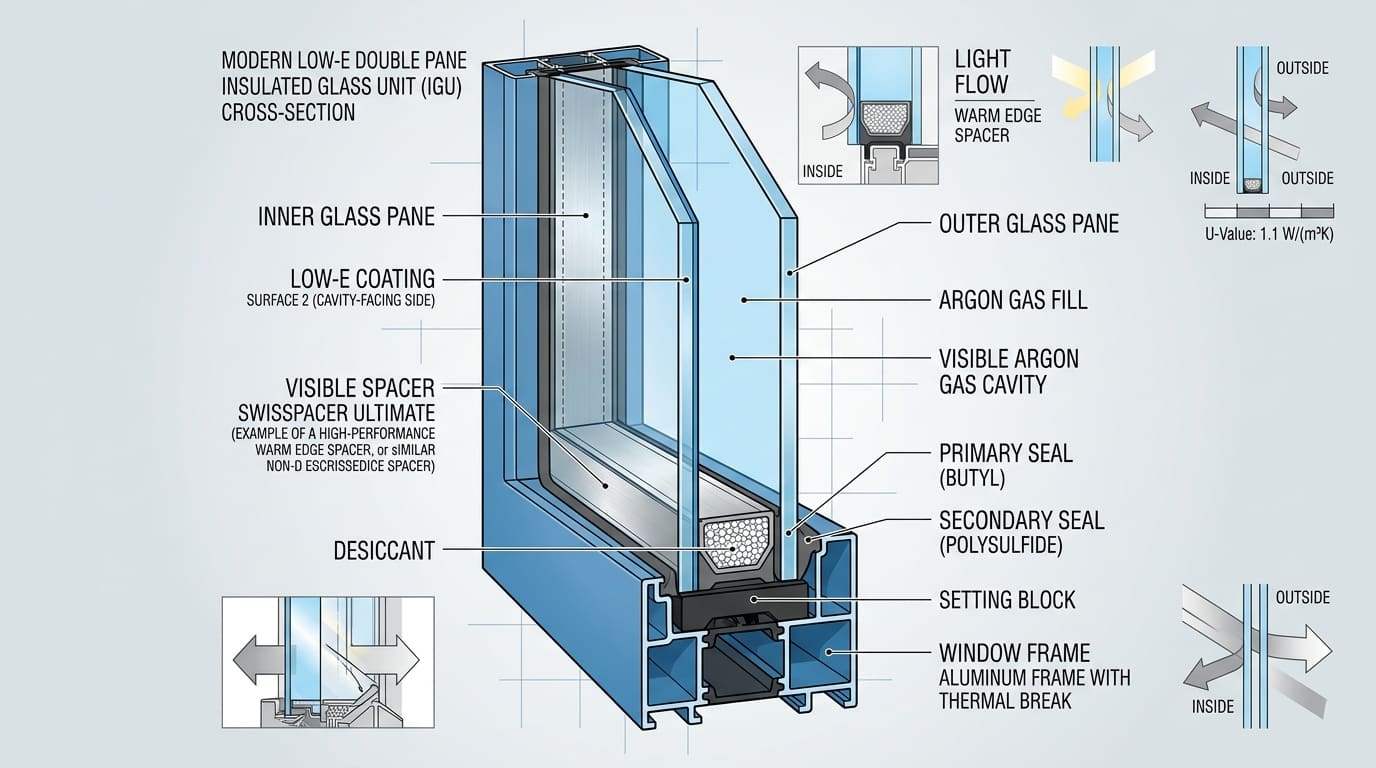
Energy-Efficient Glass Upgrades for DMV Homes: Low-E, Argon & Beyond
10 min read
Low-E Glass Explained: Is It Worth the Upgrade for Your DMV Home?
7 min read
When to Upgrade from Single-Pane to Double-Pane Windows in the DMV
8 min read
How Glass Replacement Saves Money on Energy Bills in the DMV
7 min readExplore More Resources
Helpful Guides
Common Problems
Related Pages
Our Services
24/7 Emergency
Board-Up & Glass
Licensed & Insured
DC, MD & VA
300+ Areas
DMV Coverage
Same-Day Service
When You Need It
Ready to Get Started?
Get a free estimate for any window or glass service across the DMV area.