Window Noise Reduction Guide for DMV Homes: STC Ratings, Laminated Glass, and What Actually Works
Living near I-66, a Metro line, or under the DCA flight path means sound intrusion is a daily reality. Here is what actually works to cut window noise — from STC ratings explained plainly to laminated glass versus IGU upgrades.
Mike Reynolds
Lead Glass Technician & Owner
In This Article
Why the DMV Is One of the Noisier Places to Own Windows
In twenty-plus years of glass work in this region, I have noticed that noise complaints cluster in very specific corridors. Homeowners within a half mile of I-66 through Arlington and Fairfax. Anyone within a few blocks of the Orange, Blue, or Silver lines. The neighborhoods under the final approach to Reagan National — Crystal City, Del Ray, and the riverfront blocks of Old Town Alexandria. And the row house blocks of Capitol Hill and Columbia Heights where street traffic noise bounces between tight masonry buildings at all hours. If you live in any of these areas and you have original or older windows, you are almost certainly getting more exterior sound than you should be.
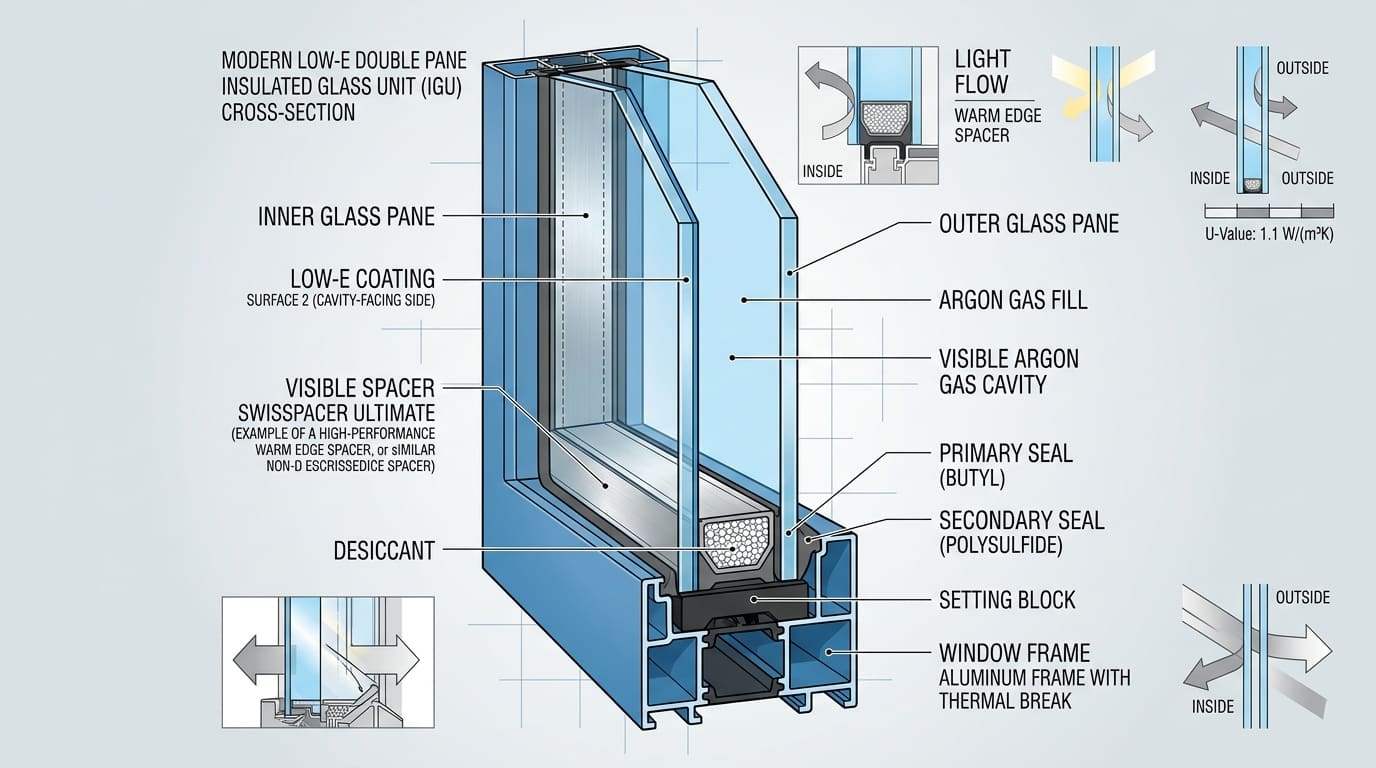
The frustrating thing about noise is that it does not show up on an energy audit. Your windows can be thermally excellent — tight seals, argon-filled, good Low-E coating — and still transmit noise at levels that disrupt sleep and concentration because acoustic performance and thermal performance use completely different physical mechanisms. A window that scores well on U-factor can score poorly on STC because the properties of glass that reduce heat conduction are unrelated to the properties that interrupt sound wave transmission.
What I want to do in this piece is give you an honest framework for understanding window noise reduction — what STC ratings mean, what kinds of glass actually reduce sound, and what you can realistically expect from a glass upgrade in a DMV home. No exaggerated claims, no selling a more expensive product than the situation calls for.
STC Ratings Explained: What the Numbers Actually Mean
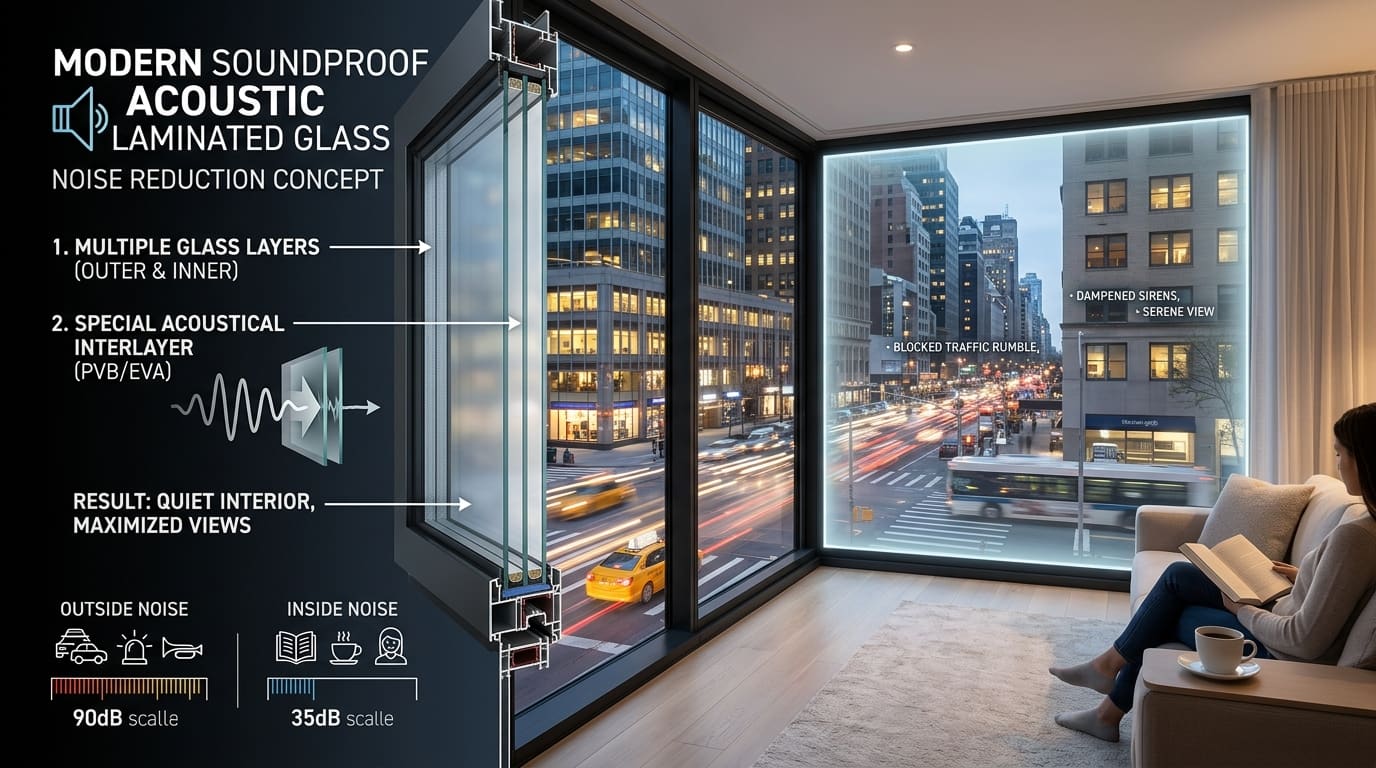
STC stands for Sound Transmission Class, and it is the industry standard rating for how much airborne sound a construction assembly (wall, floor, window, or door) reduces. The scale is logarithmic and roughly correlates to perception: an STC increase of 10 points represents approximately a halving of perceived loudness. A single-pane 1/8-inch window typically measures around STC 27. A standard dual-pane IGU of two 1/8-inch panes with a half-inch airspace measures around STC 26 to 28 — almost no improvement over single-pane, which surprises most people. A laminated glass pane of two layers with a PVB interlayer typically measures STC 35 to 38 depending on thickness.
What these numbers mean in practice: at STC 27, loud speech is audible and mostly intelligible through the window. At STC 35, loud speech is heard as a murmur but not intelligible. At STC 45, loud speech is faint. For homeowners near I-66 or under the DCA flight path, the practical target is typically STC 40 to 45 — a range where traffic and aircraft noise are reduced to background level rather than intrusion. Getting there requires either laminated glass, a large-airspace IGU with laminated panes, or a secondary interior window assembly.
One thing worth knowing: STC ratings are measured in laboratory conditions with sealed test assemblies. In a real installation, the acoustic performance of a window is limited by the weakest element — and that is almost always the air gaps in the frame-to-wall seal, not the glass itself. A high-STC glass unit installed with poorly sealed framing will underperform its rating significantly. When we do noise-reduction window work, we treat the framing seal and the glass as a combined system, because the glass upgrade is wasted if the frame is leaking sound around the edges.
Laminated Glass vs IGU for Noise: When to Use Each
Laminated glass reduces noise through a different mechanism than IGU (insulated glass units). Laminated glass — two glass layers bonded with a PVB or acoustic PVB interlayer — works by damping vibration at the interlayer. The interlayer acts as a viscoelastic material that absorbs energy from sound waves rather than transmitting it directly through the glass. This is the same mechanism used in automotive windshields, and it is very effective at the mid- and high-frequency ranges that include speech, traffic, and aircraft noise.
Standard double-pane IGU improves noise primarily through the airspace between panes, which provides some acoustic isolation. However, a standard half-inch airspace between same-thickness panes creates a resonance condition that actually amplifies certain frequencies — typically in the 200 to 500 Hz range that includes truck engine rumble and bass-heavy traffic noise. This is why standard IGU often does not subjectively reduce traffic noise as much as homeowners expect even when it significantly improves thermal performance. The acoustic resonance effect partially cancels the airspace benefit at those frequencies.
The best acoustic performance combines both mechanisms: an IGU built with at least one laminated pane, asymmetric glass thicknesses (such as 3mm and 5mm rather than two identical panes), and a wider-than-standard airspace of 3/4 inch to 1 inch. This combination breaks the resonance condition, adds laminate damping, and maximizes airspace isolation. For a homeowner near I-66 or on the DCA flight path, this type of acoustic IGU is what I would recommend — not a simple swap to laminated single-pane, which gives you noise reduction but sacrifices thermal performance, and not a standard IGU, which gives you thermal performance but disappoints on noise.
The DCA Flight Path Situation
Reagan National approaches come in over the Potomac and touch down heading northeast, meaning the loudest aircraft noise falls on the west-facing and north-facing windows of homes in Del Ray, Rosemont, and the Braddock Road corridor. The noise profile of jet aircraft on approach is dominated by mid-frequency content — a combination of engine fan noise and airframe aerodynamic noise — that sits squarely in the range where acoustic laminated glass excels. Homeowners in these neighborhoods who have gone through a glass upgrade specifically for aircraft noise reduction consistently report meaningful improvement, though not elimination — aircraft at very close range are loud enough to penetrate even STC 45 assemblies to some degree.
If you live in the flight path corridor and are seriously considering acoustic glass, it is worth checking whether your home is in an area that has received FAA noise insulation program funding. The Metropolitan Washington Airports Authority has administered noise insulation programs for qualifying properties near Reagan National in past years. These programs have covered window upgrades for eligible homeowners at no or low cost. Availability and eligibility requirements change, so checking directly with MWAA or the Alexandria or Arlington noise offices is worth the time before you spend out of pocket.
Metro Corridor Homes: Orange, Blue, Silver Lines
Ground-level Metro operations generate a distinct noise profile from surface-running segments: rail squeal on curves, the rumble of heavy rail cars, and the doppler sweep of trains passing at speed. In neighborhoods like East Falls Church, Ballston, and the Rosslyn-Ballston corridor where the Orange and Silver lines run at or near grade, homes within a block of the track can experience noise events of 70 to 75 decibels from passing trains — loud enough to interrupt conversation and sleep. Elevated sections like the Blue Line over the Potomac approach and parts of the Yellow Line generate similar profiles.
For these applications, the wide-airspace acoustic IGU approach is particularly effective because the low-frequency rumble component of rail noise benefits significantly from the larger airspace. A 1-inch airspace with a 5mm laminated exterior pane and 4mm interior pane is a configuration we have used successfully in Ballston and Rosslyn row houses with documented subjective improvement from residents. The improvement is not a cure — you will still be aware of trains passing — but it takes the noise from intrusion level to awareness level, which is a meaningful quality-of-life change.
What a Noise Reduction Project Actually Looks Like
Most noise reduction glass work in DMV homes involves replacing just the glass units within existing frames rather than full window replacement. This is usually the right approach: the frames in most DMV homes from the 1990s onward are structurally fine, and replacing the glass only avoids the cost and disruption of frame removal, drywall repair, trim replacement, and painting. We measure the existing glass unit, fabricate an acoustic replacement unit to spec, and install it in the same frame with attention to the frame seal as described above. The total project is typically completed in a few hours per window.
If your frames are original 1970s or 1980s aluminum with no thermal break, a full window replacement makes more sense because the frames themselves are a significant thermal and acoustic weak point. In that case, the glass upgrade and frame upgrade happen together, and you get combined acoustic and thermal improvement that justifies the larger investment. For the Bethesda and Chevy Chase homes with original aluminum double-hungs I see regularly, this full replacement approach is often the right call.
We do noise reduction glass work throughout the DMV — Arlington, Alexandria, Bethesda, Silver Spring, Capitol Hill, and beyond. If you are dealing with I-66, Metro, DCA, or street noise that is affecting your sleep or quality of life, call us at (703) 470-7867 for a free consultation. We will assess your specific situation and give you an honest recommendation about what level of improvement is realistically achievable and at what cost.
About the Author
Mike Reynolds
Lead Glass Technician & Owner
With over 15 years of experience in window and glass repair across the DC, Maryland, and Virginia area, Mike shares practical expertise to help homeowners and businesses make informed decisions about their glass repair and replacement needs.
Need Help With Your Glass?
Our experts are ready to help with any window or glass issue. Free estimates, same-day service available across DC, MD & VA.
Related Articles
Continue reading about guides
More Guides
View All
How to Tell If Your Window Glass Needs Repair or Replacement
8 min read
Stress Cracks in Windows: Causes, Prevention & Solutions for DMV Homeowners
7 min read
Foggy Windows: Why Double-Pane Seals Fail & What to Do About It
9 min read
Glass Replacement in Historic DMV Homes: Preservation Meets Performance
9 min readExplore More Resources
Helpful Guides
Common Problems
Related Pages
Our Services
24/7 Emergency
Board-Up & Glass
Licensed & Insured
DC, MD & VA
300+ Areas
DMV Coverage
Same-Day Service
When You Need It
Ready to Get Started?
Get a free estimate for any window or glass service across the DMV area.