Window Glass Types Explained: The Definitive Guide for DMV Homeowners
Every type of window glass explained — float, tempered, laminated, Low-E, insulated, tinted, wired, and more. Virginia Glass Windows helps DMV homeowners choose the right glass for every window.
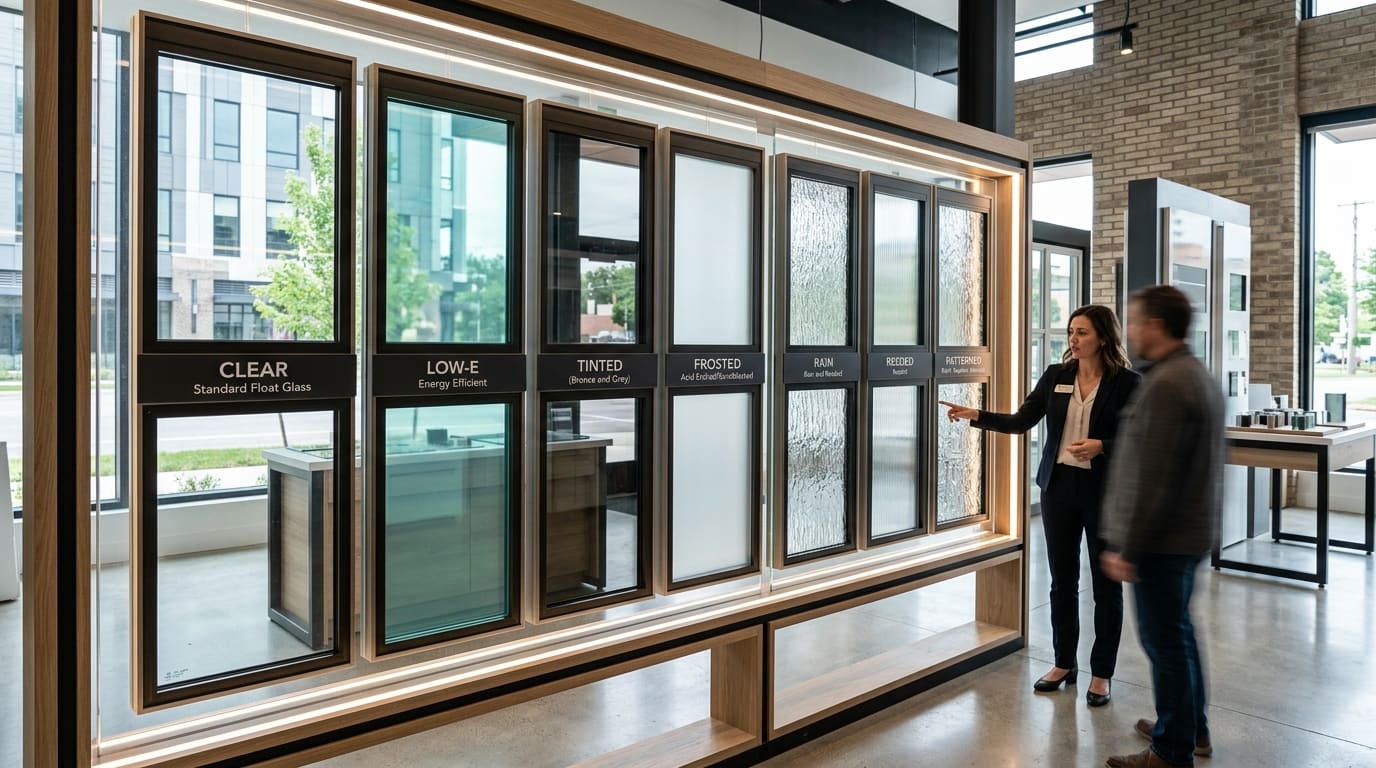
Why Glass Type Matters More Than You Think
Key Properties
The glass in your windows is not a commodity — it is a performance product that directly affects your energy bills, your security, your comfort, and the value of your home. In the Washington DC metropolitan area, where summer temperatures exceed 95 degrees and winter drops below freezing, choosing the right glass type for each window location can reduce energy costs by 20 to 30 percent and transform uncomfortable rooms into pleasant living spaces.
Understanding glass types empowers you to make informed decisions during repairs, replacements, and upgrades. Whether you are replacing a single cracked pane, upgrading failed insulated glass units, or planning a whole-home glass improvement project, knowing what each glass type offers — and where it performs best — ensures you get the maximum return on your investment.
This guide covers every glass type you will encounter in DMV residential and commercial windows, from the most basic float glass found in pre-1970 homes to the most advanced triple-pane krypton-filled units in premium new construction.
Float Glass (Annealed Glass) — The Foundation
Key Properties
Float glass is the baseline product of the glass industry, manufactured by floating molten glass on a bed of molten tin to produce a flat, uniform sheet. The process, invented in 1959, produces glass with near-perfect optical clarity and consistent thickness. Virtually all other glass types — tempered, laminated, Low-E, insulated — start as float glass before undergoing additional processing.
Standard float glass is available in thicknesses from 1/16 inch (used in picture frames) to 1 inch or more (used in commercial applications). Residential windows typically use 1/8 inch (single-strength) or 5/32 inch (double-strength) float glass. Double-strength is preferred for its greater durability and resistance to flexing in wind.
The major limitation of annealed float glass is how it breaks — into large, sharp, dagger-like shards that can cause serious injury. Building codes throughout DC, Maryland, and Virginia restrict its use in hazardous locations including doors, windows near doors, bathrooms, windows below 18 inches from the floor, and windows adjacent to stairways. In these locations, tempered or laminated safety glass is required.
Float glass provides minimal insulation (R-value approximately 1.0 for a single pane) and transmits nearly all ultraviolet radiation, which fades furniture, floors, and artwork. For DMV homeowners with single-pane float glass windows, upgrading to insulated Low-E glass provides one of the most dramatic energy improvements available.
Tempered Glass — Safety Through Strength
Key Properties
Tempered glass is float glass that has been heated to approximately 1,200 degrees Fahrenheit and then rapidly cooled using precisely controlled air jets. This rapid cooling creates balanced internal stresses — the outer surfaces are in compression while the interior is in tension — that make the glass roughly four times stronger than annealed glass of the same thickness.
The defining characteristic of tempered glass is its fracture behavior. When tempered glass breaks, the entire pane shatters into thousands of small, roughly cube-shaped pieces with blunt edges. While you can still cut yourself on tempered glass fragments, the injury risk is dramatically lower than the large, knife-like shards produced by annealed glass. This fracture pattern is why tempered glass is classified as "safety glass" by building codes.
Building codes in Washington DC, Maryland, and Virginia require tempered glass in specific locations: within 18 inches of a door opening, in any door containing glass, in sidelights flanking entry doors, in all shower and tub enclosures, in windows with a sill height below 18 inches from the floor, in stairway windows below 60 inches from the floor, and in any glass panel adjacent to a walking surface or pool. Failure to use tempered glass in these locations is a code violation that home inspectors flag during pre-sale inspections.
One critical limitation: tempered glass cannot be cut, drilled, or modified after tempering. Any cutting would release the balanced internal stresses and cause the entire pane to shatter. Tempered glass must be ordered to exact final dimensions before the tempering process. This is why precise measurement is essential when ordering tempered replacement glass — there is no trimming to fit on-site.
Tempered glass costs approximately 25 to 50 percent more than annealed float glass, a modest premium for the safety it provides. For DMV homeowners, we verify code requirements at every window during replacement and ensure tempered glass is installed wherever it is required.
Laminated Glass — Security, Sound, and UV Protection
Key Properties
Laminated glass consists of two or more panes of glass permanently bonded to a tough plastic interlayer — typically polyvinyl butyral (PVB) or, for higher-performance applications, SentryGlas Plus (SGP). The glass-interlayer-glass sandwich is bonded under heat and pressure in an autoclave, creating a permanent, inseparable composite.
When laminated glass is struck with enough force to break it, the glass cracks but the interlayer holds the broken pieces firmly in place. The window remains intact as a barrier — cracked but not breached. This is the same technology used in automobile windshields and is the single most effective glass upgrade for residential security. An intruder who breaks a laminated glass window still faces a tough, elastic membrane that requires sustained, noisy effort to breach — buying critical time for alarm response and deterring most opportunistic break-in attempts.
Beyond security, laminated glass provides two additional benefits that are particularly valuable in the DMV area. First, sound reduction: the PVB interlayer dampens sound vibrations that would otherwise pass through the glass, achieving Sound Transmission Class (STC) ratings of 34 to 45 compared to 26 to 28 for standard single-pane glass. This makes laminated glass ideal for homes near Reagan National Airport flight paths in Arlington and Crystal City, along I-495, I-66, and I-270 highway corridors, and near Metro surface tracks in Silver Spring, Bethesda, and Alexandria.
Second, UV protection: laminated glass blocks 99 percent of ultraviolet radiation regardless of the visible tint level. UV radiation is responsible for the progressive fading and deterioration of hardwood floors, furniture fabrics, artwork, and leather — damage that can cost thousands of dollars over the life of a home. For DMV homes with large south or west-facing windows in neighborhoods like Cleveland Park, Chevy Chase, Bethesda, and McLean, the UV protection alone justifies the investment.
Laminated glass costs approximately 50 to 100 percent more than standard annealed glass, but the security, sound reduction, and UV protection benefits make it the recommended upgrade for ground-floor windows, glass adjacent to entry doors, and any window facing a significant noise source.
Low-E Glass — The Energy Efficiency Standard
Key Properties
Low-emissivity (Low-E) glass features a microscopically thin coating of metallic oxide — typically silver, tin oxide, or a multi-layer stack of metals and dielectrics — deposited on one surface of the glass. This coating is invisible to the naked eye but fundamentally changes how the glass interacts with radiant heat energy. Low-E coatings reflect long-wave infrared radiation (heat) while allowing short-wave visible light to pass through.
There are two broad categories of Low-E coatings, and matching the right type to the right window orientation is critical for maximizing performance in the DMV climate. Solar-control Low-E coatings are optimized to reflect incoming solar radiation before it enters the building — ideal for south-facing and west-facing windows where summer solar heat gain drives cooling costs. Passive-retention Low-E coatings have a higher solar heat gain coefficient, allowing more solar energy in while excelling at reflecting interior heat back into the room — better for north-facing windows where winter heat retention is the priority.
The manufacturing method also matters. "Hard-coat" (pyrolytic) Low-E is applied during the glass manufacturing process while the glass is still hot, producing a durable coating that can be exposed to the air. "Soft-coat" (MSVD — magnetron sputter vacuum deposition) Low-E is applied in a vacuum chamber after the glass is manufactured, producing a more delicate but higher-performing coating that must be protected inside a sealed insulated glass unit. Soft-coat Low-E dominates the residential market because its superior performance justifies the requirement to be inside an IGU.
The energy impact is substantial. A south-facing window with solar-control Low-E glass can reduce summer heat gain by 25 to 45 percent compared to clear glass. The Department of Energy estimates that upgrading from clear glass to Low-E in a mixed heating-cooling climate like Washington DC reduces window-related energy costs by 12 to 30 percent. For a typical DMV home, this translates to meaningful monthly savings that compound over the 20-plus year lifespan of the glass.
Low-E glass also blocks 99 percent of ultraviolet radiation — protecting your floors, furniture, and artwork from fading without any visible tinting effect. The coating adds a relatively modest 15 to 25 percent to the cost of the glass, making it the single most cost-effective glass upgrade available. We recommend Low-E coating on virtually every glass replacement and upgrade project in the DMV.
Insulated Glass Units (IGUs) — The Modern Standard
Key Properties
An insulated glass unit is a factory-assembled system consisting of two or three glass panes separated by a hollow spacer, sealed around the perimeter with primary and secondary sealants, and filled with an insulating gas — typically argon or krypton — in the cavity between the panes. The spacer contains a molecular sieve desiccant that absorbs any trace moisture present during fabrication.
IGUs are the backbone of modern window performance. A double-pane IGU with Low-E coating and argon gas fill achieves an R-value of 3.0 to 4.0 — three to four times the insulating value of a single pane of glass. Triple-pane IGUs with krypton fill and dual Low-E coatings can reach R-5.0 to R-6.0, approaching the insulating value of a framed wall. In the DMV climate, where both summer cooling and winter heating costs are significant, this insulating performance directly reduces energy bills.
The gas fill contributes meaningfully to performance. Argon is approximately 34 percent denser than air and conducts heat about 67 percent as effectively, providing 15 to 20 percent better thermal resistance than an air-filled cavity. Krypton is even denser and a poorer heat conductor than argon, providing superior insulation in narrower cavities — making it ideal for triple-pane units and thin-profile IGUs. All quality residential IGUs manufactured today use argon as the standard fill gas.
The spacer separating the panes plays a critical role in both seal longevity and edge-of-glass performance. Traditional aluminum spacers are excellent heat conductors, creating a "thermal bridge" at the glass perimeter that reduces effective R-value and causes condensation rings in cold weather. Warm-edge spacers — made from polymer, stainless steel, or foam composites — conduct far less heat, eliminating the thermal bridge and improving both comfort and performance. We specify warm-edge spacers on all replacement IGUs.
IGU seal failure is the most common glass problem in DMV homes with windows 15 to 25 years old. When the perimeter seal degrades, the insulating gas escapes and moisture-laden air infiltrates the cavity, causing the persistent fog between panes that signals the end of the unit's useful life. The only permanent fix is replacing the failed IGU with a new factory-sealed unit — a straightforward process that preserves your existing frame.
Triple-Pane Glass — Maximum Performance
Key Properties
Triple-pane glass uses three panes of glass with two sealed cavities, each filled with insulating gas and typically featuring Low-E coatings on two or more interior surfaces. The result is the highest-performing window glass commercially available, with R-values of 5.0 to 8.0 depending on gas fill, coating specifications, and glass thickness.
Triple-pane glass is most cost-effective in high-performance homes, passive-house construction, and rooms with very large window areas that face extreme weather exposure. In the DMV area, triple-pane is found primarily in premium custom homes in Great Falls, McLean, Potomac, and Chevy Chase, as well as in certified green building projects and high-performance renovations.
For most DMV homeowners, the jump from double-pane Low-E argon to triple-pane offers diminishing returns relative to the significant additional cost. However, for north-facing rooms that are chronically cold in winter, for rooms with floor-to-ceiling glass walls, and for homeowners pursuing maximum energy performance, triple-pane delivers measurable additional comfort and savings.
Tinted Glass — Glare and Heat Control
Key Properties
Tinted glass has metallic oxides added to the glass batch during manufacturing, producing glass with a permanent color that reduces visible light transmission and solar heat gain. Common tints include gray (reduces overall brightness), bronze (warm tone, popular for residential), green (absorbs infrared heat), and blue (aesthetic preference).
Tinted glass is most commonly used in commercial applications — office buildings, storefronts, and institutional buildings throughout the DMV where controlling glare and solar heat gain is important. In residential applications, tinted glass has largely been replaced by Low-E coatings, which provide better heat control with less visible light reduction. However, tinted glass combined with Low-E coating can provide both aesthetic color and maximum solar control for homes with extreme sun exposure.
Obscured and Decorative Glass — Privacy With Light
Key Properties
Obscured glass — also called textured, patterned, or privacy glass — allows natural light to pass through while preventing clear visibility. The texture is created by passing the glass through patterned rollers during manufacturing. Common patterns include rain, reed, frosted, hammered, glue-chip, and dozens of decorative options.
In DMV homes, obscured glass is most commonly used in bathroom windows, front door sidelights, glass partitions, and any location where privacy is needed without sacrificing natural light. Frosted glass in particular has become popular in modern bathroom renovations throughout Arlington, Bethesda, and DC as a clean alternative to curtains or blinds.
Obscured glass can be combined with tempered, laminated, or insulated construction for locations that require both privacy and safety, security, or energy performance. Custom decorative glass — etched, carved, stained, or leaded — adds architectural character and is especially valued in historic DMV homes where entry door sidelights and transom windows feature distinctive decorative patterns.
Wired Glass and Fire-Rated Glass
Key Properties
Wired glass has a wire mesh embedded during the manufacturing process. Traditionally used in commercial fire-rated applications — school corridor windows, stairwell doors, and fire-barrier walls — the wire holds the glass in place during a fire, preventing flames and smoke from passing through the opening even as the glass cracks from heat.
Modern fire-rated glass products, including ceramic glass and intumescent-interlayer glass, are increasingly replacing wired glass in new construction because they provide fire protection without the wire mesh that reduces visibility and creates a dated appearance. However, wired glass remains common in existing DMV commercial buildings and schools built before 2000.
Fire-rated glass must be specified and installed according to the fire rating of the wall or door assembly it serves — typically 20-minute, 45-minute, 60-minute, or 90-minute ratings. Using non-rated glass in a fire-rated assembly violates building code and compromises life safety. We handle fire-rated glass replacement in commercial buildings throughout the DMV with proper documentation of the rating specifications.
Choosing the Right Glass for Every Window in Your DMV Home
Key Properties
The best glass choice depends on the specific window location, its cardinal orientation, local code requirements, and your performance priorities. Here is our recommended approach for DMV homes:
South-facing and west-facing windows: Double-pane IGU with solar-control Low-E and argon fill. These windows receive the most solar heat gain, and solar-control coatings deliver the biggest energy savings.
North-facing windows: Double-pane IGU with passive-retention Low-E and argon fill. These windows benefit from coatings that allow some solar gain while reflecting interior heat back into the room during winter.
Code-required safety locations (near doors, bathrooms, low sill heights, stairways): Tempered safety glass, which can also be Low-E coated and insulated for combined safety and energy performance.
Ground-floor windows in security-sensitive locations: Laminated glass for hold-together security, combined with Low-E and insulated construction for energy performance.
Windows facing noise sources (highways, airports, Metro): Laminated glass for sound reduction (STC 34-45), which also provides security and UV protection benefits.
Historic homes in preservation districts: Restoration-grade glass or interior storm window inserts that preserve the exterior appearance while improving performance.
Our technicians assess each window individually during every estimate visit and recommend the optimal glass type based on its specific requirements — not a one-size-fits-all specification that ignores the differences between windows.
Need Help With Your Glass?
Send us a photo of your window or glass issue and get a free estimate within hours. Our experts serve all of DC, Maryland, and Virginia.
Common Questions
Frequently Asked Questions
Answers to common questions about this topic from our DMV glass experts.
Keep Reading
Related Guides
Explore More Resources
Related Articles
Common Problems
Our Services
Ready to Get Started?
Get a free estimate from our glass experts. Same-day service available across DC, MD & VA.