
Glass Thickness Guide: How to Choose the Right Thickness
Glass thickness affects strength, safety, insulation, and cost. From 3/32-inch picture frame glass to 3/4-inch structural panels, here is how to choose the right thickness for every application.
Mike Reynolds
Lead Glass Technician & Owner
In This Article
Standard Glass Thicknesses Explained
Glass is manufactured in a range of standard thicknesses, each suited to specific applications based on the strength, weight, and performance requirements of the installation. Understanding these standards helps you make informed decisions when ordering replacement glass or planning a new installation. In the United States, glass thickness is expressed in fractions of an inch, while metric equivalents are used in manufacturing specifications.
The most common architectural glass thicknesses are 3/32 inch (2.5 mm), 1/8 inch (3 mm), 5/32 inch (4 mm), 3/16 inch (5 mm), 1/4 inch (6 mm), 3/8 inch (10 mm), 1/2 inch (12 mm), and 3/4 inch (19 mm). Each step up in thickness increases the strength and weight of the glass substantially. A 1/4-inch pane is roughly twice as strong as a 1/8-inch pane of the same dimensions, and doubling the thickness quadruples the load-bearing capacity. This relationship between thickness and strength is why choosing the correct thickness is not just a matter of preference — it is a matter of structural integrity and safety.
Glass Thickness for Windows
Standard single-pane residential windows typically use 1/8-inch (3 mm) or 3/32-inch (2.5 mm) glass. These thicknesses are adequate for small to medium window openings in protected locations. However, for larger windows — anything over approximately 12 square feet — the glass thickness must increase to 5/32 inch (4 mm) or 3/16 inch (5 mm) to withstand wind loads and prevent excessive flexing. In the DMV area, where wind loads during summer thunderstorms and nor'easters can be substantial, proper glass thickness is essential for windows on upper floors and exposed elevations.
Double-pane insulated glass units (IGUs) used in most modern DMV homes typically consist of two panes of 1/8-inch glass separated by a spacer. For larger IGU panels, the individual panes may step up to 5/32 inch or 3/16 inch. Low-E coatings and gas fills add performance without changing the glass thickness. When replacing glass in an existing IGU, matching the original pane thickness precisely is critical — even a 1/32-inch mismatch can prevent the replacement pane from seating properly in the spacer system.
Impact-resistant and security windows use thicker glass — typically 1/4 inch for tempered single panes or laminated constructions with two 1/8-inch panes bonded to a plastic interlayer. Building codes in the DMV area require safety glazing (tempered or laminated) in hazardous locations regardless of thickness, so the code requirement and the thickness requirement work together to determine the correct glass specification.
Glass Thickness for Doors and Shower Enclosures
Door glass applications demand thicker glass than windows because of the higher impact risk and the structural role the glass plays in frameless designs. Framed glass doors — such as French doors and entry door sidelights — typically use 1/8-inch or 3/16-inch tempered glass held securely in a rigid frame. The frame provides structural support, so the glass thickness can be moderate. However, when the glass panel is large — as in a sliding patio door — 3/16-inch or 1/4-inch tempered glass is standard to handle the weight, wind load, and operational stress.
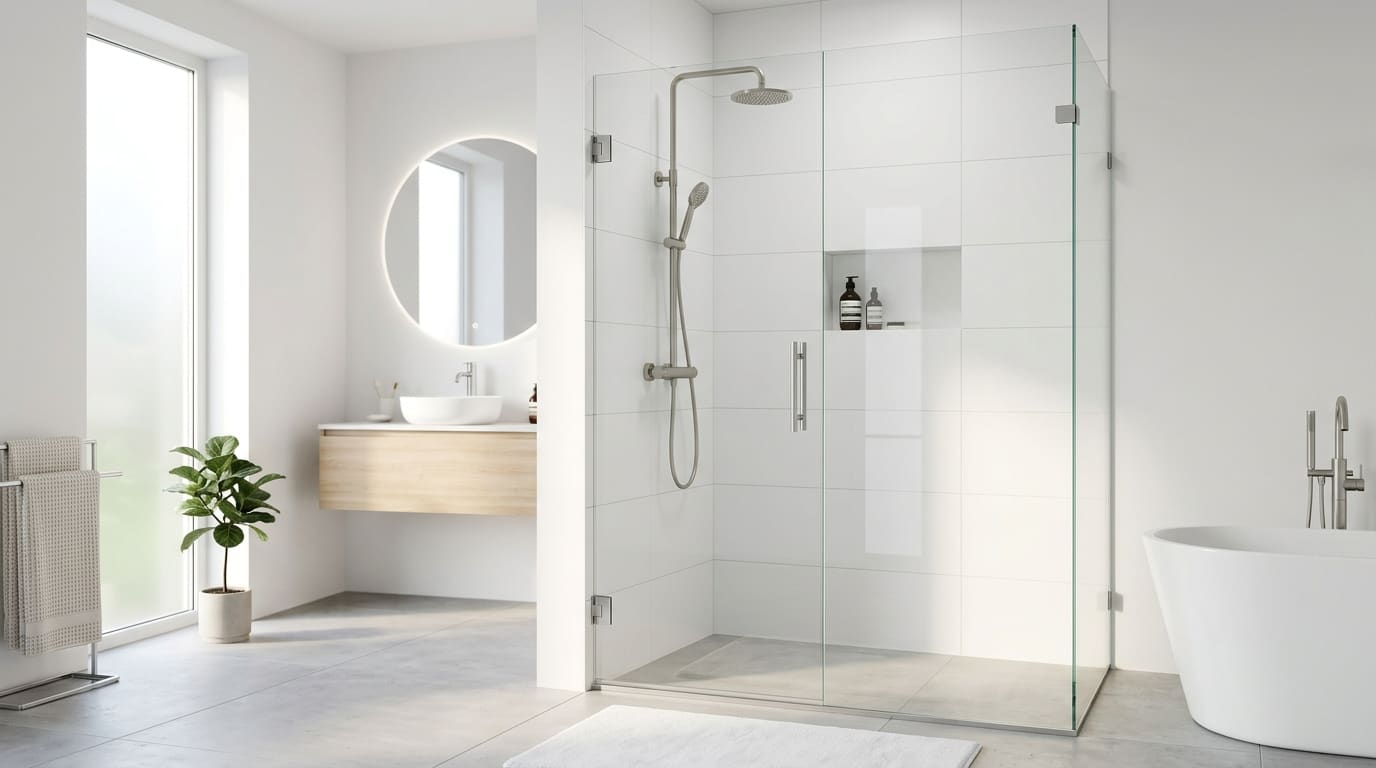
Shower enclosures represent one of the most thickness-critical glass applications in residential construction. Framed shower doors use 3/16-inch (5 mm) tempered glass as a minimum, with the metal frame providing structural support. Semi-frameless designs step up to 1/4-inch (6 mm) tempered glass. Frameless shower enclosures — the most popular style in DMV bathroom renovations — require 3/8-inch (10 mm) or 1/2-inch (12 mm) tempered glass because the glass must support itself without a frame. The hinges, clips, and channels attach directly to the glass edge, concentrating all structural loads on the glass itself.
For frameless shower doors, 3/8-inch glass is the standard choice that balances strength, weight, and cost. Half-inch glass provides a more substantial feel and added rigidity for very large panels or heavy door configurations, but it also weighs significantly more — approximately 6.5 pounds per square foot compared to 5 pounds for 3/8-inch glass — which affects hardware selection and wall reinforcement requirements.
Glass Thickness for Tabletops, Shelves, and Furniture
Glass tabletops require thickness selection based on the table size, support configuration, and intended use. A small end table or coffee table top that rests on a solid base can use 1/4-inch tempered glass. Dining tables and conference tables with pedestal bases or trestle supports need 3/8-inch or 1/2-inch tempered glass to span the unsupported areas without excessive flexing. Very large tables — those exceeding 48 inches in any unsupported span — should use 1/2-inch or 3/4-inch tempered glass for rigidity and to prevent the unnerving visual deflection that thinner glass exhibits under load.
Glass shelves follow similar principles but with the added consideration of sustained loads. A decorative glass shelf displaying lightweight items in a shadow box can use 1/4-inch tempered glass. Shelves in bathroom niches and kitchen display areas that hold moderate weight — toiletries, dishes, books — should use 3/8-inch tempered glass for spans up to 24 inches and 1/2-inch for longer spans. Heavy-duty shelving applications — retail display fixtures, trophy cases, bar shelving holding bottles — typically require 1/2-inch or thicker tempered glass with appropriate bracket spacing.
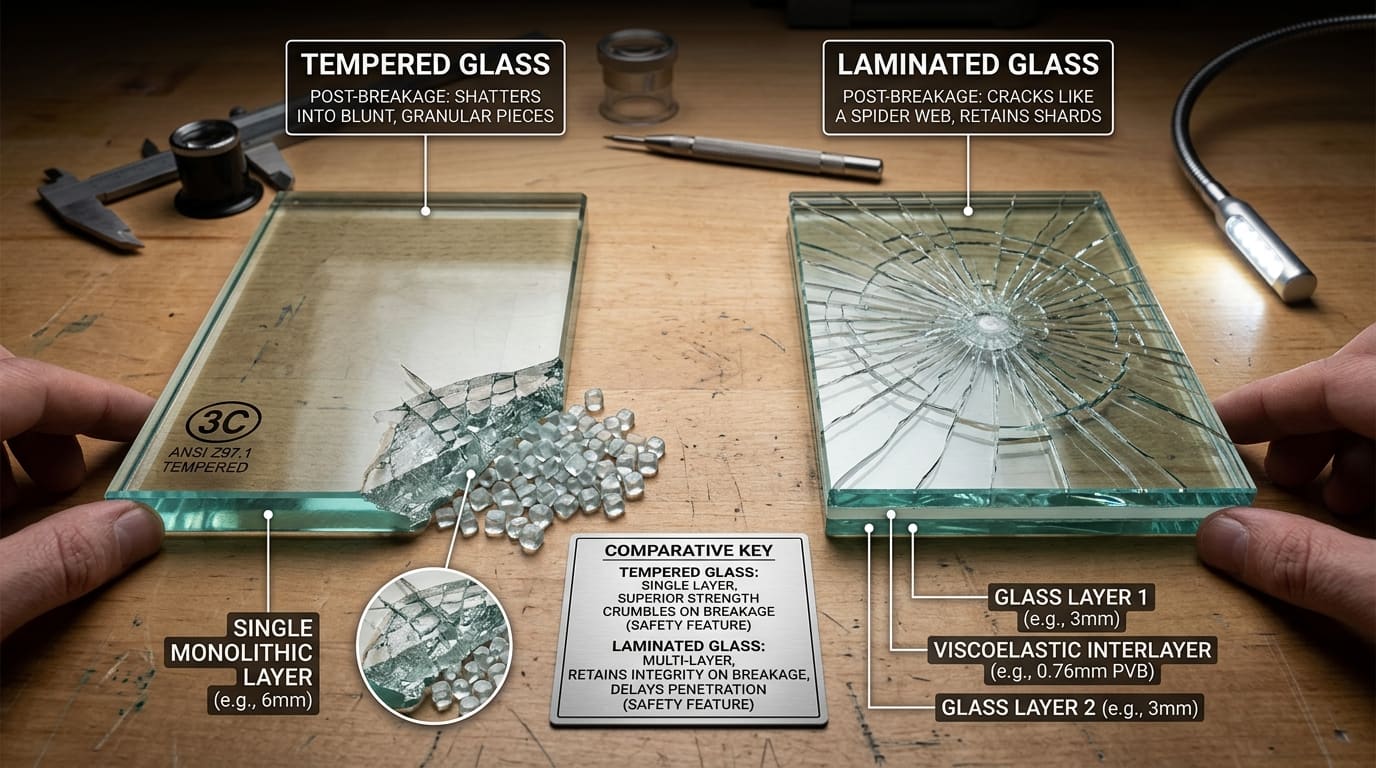
For all furniture glass applications, we strongly recommend tempered glass for safety. If the glass breaks, tempered glass fractures into small, relatively harmless granules rather than large, dangerous shards. This is especially important for tabletops in homes with children and for shelves mounted at any height where a falling shard could cause injury.
Glass Thickness for Railings and Structural Applications
Glass railings, balustrades, and structural glass applications have the most demanding thickness requirements because human safety depends directly on the glass performing under load. Residential deck and balcony railings in the DMV area typically require 1/2-inch tempered or laminated glass as a minimum when set in a channel or base shoe system. Many jurisdictions and engineers specify 9/16-inch or 5/8-inch laminated glass (two layers of 1/4-inch glass bonded with a structural interlayer) for added safety — if one layer breaks, the other maintains the barrier.
Pool fencing, which must meet stringent safety codes in all DMV jurisdictions, typically uses 1/2-inch tempered glass panels. The glass must withstand wind loads, resist impact from pool toys and activities, and maintain its structural integrity over years of UV exposure and weather cycling. For frameless glass pool fencing where the panels are anchored only at the base, the glass thickness and the engineering of the base shoe system work together to meet code-required load ratings.
When specifying glass for railings or structural applications, always work with a qualified glass professional and, when required, a structural engineer. Building codes in Washington DC, Maryland, and Virginia each have specific requirements for glass in guard and barrier applications, and these requirements specify not just the thickness but also the glass type (tempered, laminated, or tempered-laminated), the maximum panel size, and the load rating. Virginia Glass Windows provides code-compliant glass railing installations throughout the region — contact us at (703) 470-7867 for a consultation on your project.
About the Author
Mike Reynolds
Lead Glass Technician & Owner
With over 15 years of experience in window and glass repair across the DC, Maryland, and Virginia area, Mike shares practical expertise to help homeowners and businesses make informed decisions about their glass repair and replacement needs.
Need Help With Your Glass?
Our experts are ready to help with any window or glass issue. Free estimates, same-day service available across DC, MD & VA.
Related Articles
Continue reading about guides

More Guides
View All
How to Tell If Your Window Glass Needs Repair or Replacement
8 min read
Stress Cracks in Windows: Causes, Prevention & Solutions for DMV Homeowners
7 min read
Foggy Windows: Why Double-Pane Seals Fail & What to Do About It
9 min read
Glass Replacement in Historic DMV Homes: Preservation Meets Performance
9 min readExplore More Resources
Helpful Guides
Common Problems
Our Services
24/7 Emergency
Board-Up & Glass
Licensed & Insured
DC, MD & VA
300+ Areas
DMV Coverage
Same-Day Service
When You Need It
Ready to Get Started?
Get a free estimate for any window or glass service across the DMV area.