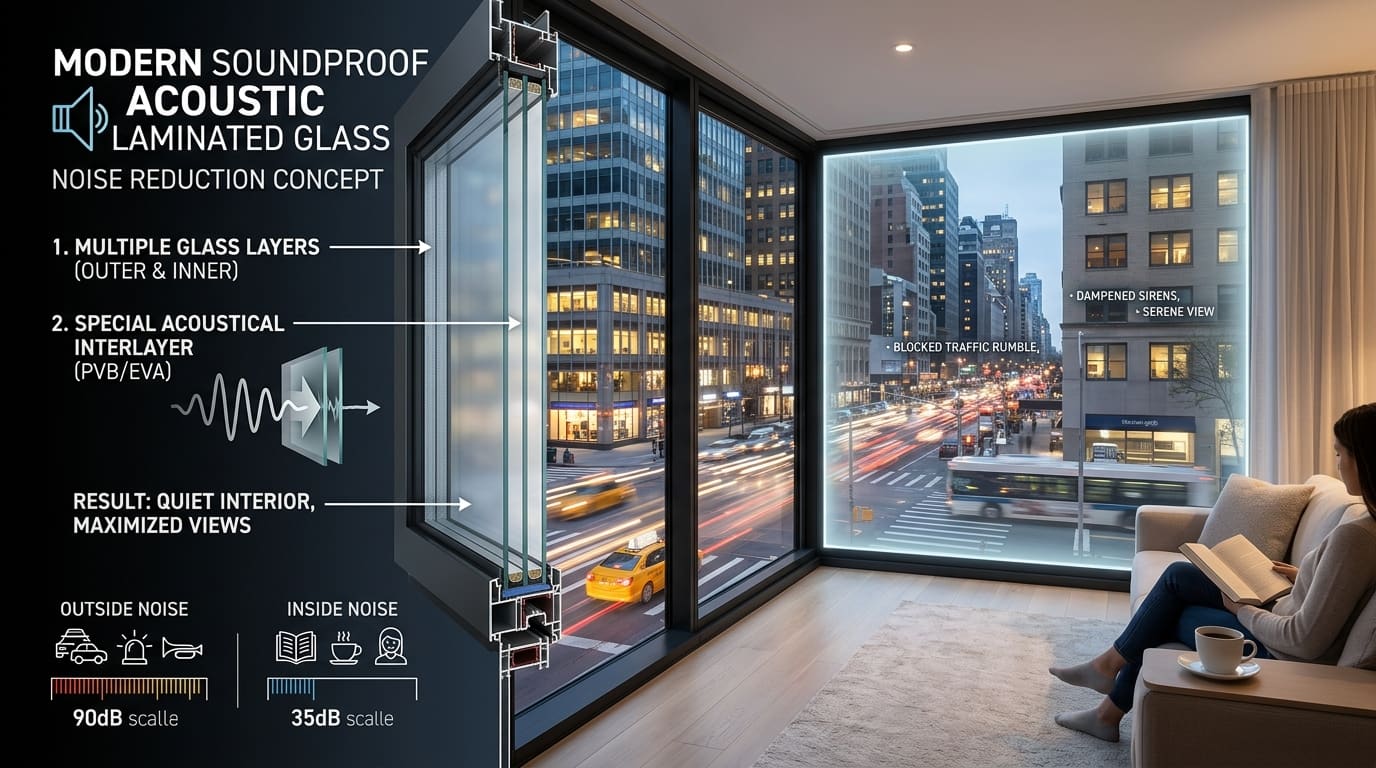
Noise Reduction Window Glass: What Actually Works in the DMV
If you live near a Metro line, a major road, or Reagan National flight path, you already know what inadequate window glass sounds like at 11pm. Here is what the glass industry knows about acoustic performance that most homeowners never get told.
Mike Reynolds
Lead Glass Technician & Owner
In This Article
Why Window Glass Is Your Biggest Noise Problem
Walls, floors, and ceilings in most residential construction are reasonably good sound barriers. A standard framed wall with drywall on both sides has an STC (Sound Transmission Class) rating around 35-40. But a single-pane window in that same wall might have an STC of 18-24. That window is by far the weakest link in your building envelope from an acoustic standpoint — sound floods through it relative to everything else around it.
In the DMV, the noise sources are relentless and varied. There are homes in Brookland and Petworth that are genuinely impacted by Red Line and Green Line Metro noise. There are neighborhoods in Arlington and Alexandria under the Reagan National approach and departure paths — the low-altitude flights on the River Visual approach mean aircraft noise is a real quality-of-life issue for tens of thousands of homes. There are older row houses in Capitol Hill, Columbia Heights, and H Street corridor where single-pane historic glass lets in everything from delivery trucks to bar crowds. And there are newer neighborhoods in Tysons, Silver Spring, and Bethesda where proximity to the Beltway or major arterials makes traffic drone a constant background. The glass choice matters enormously in all of these situations.
Understanding STC Ratings for Window Glass
STC is the standard rating system for sound transmission through building assemblies. Higher numbers mean better sound isolation. The STC scale is logarithmic — a 10-point increase represents roughly a doubling of perceived noise reduction. Here is a practical reference: an STC of 25 means loud speech is clearly audible through the window. An STC of 35 means loud speech is audible but not intelligible. An STC of 45 means loud speech is barely audible, and most traffic and general urban noise is significantly reduced.
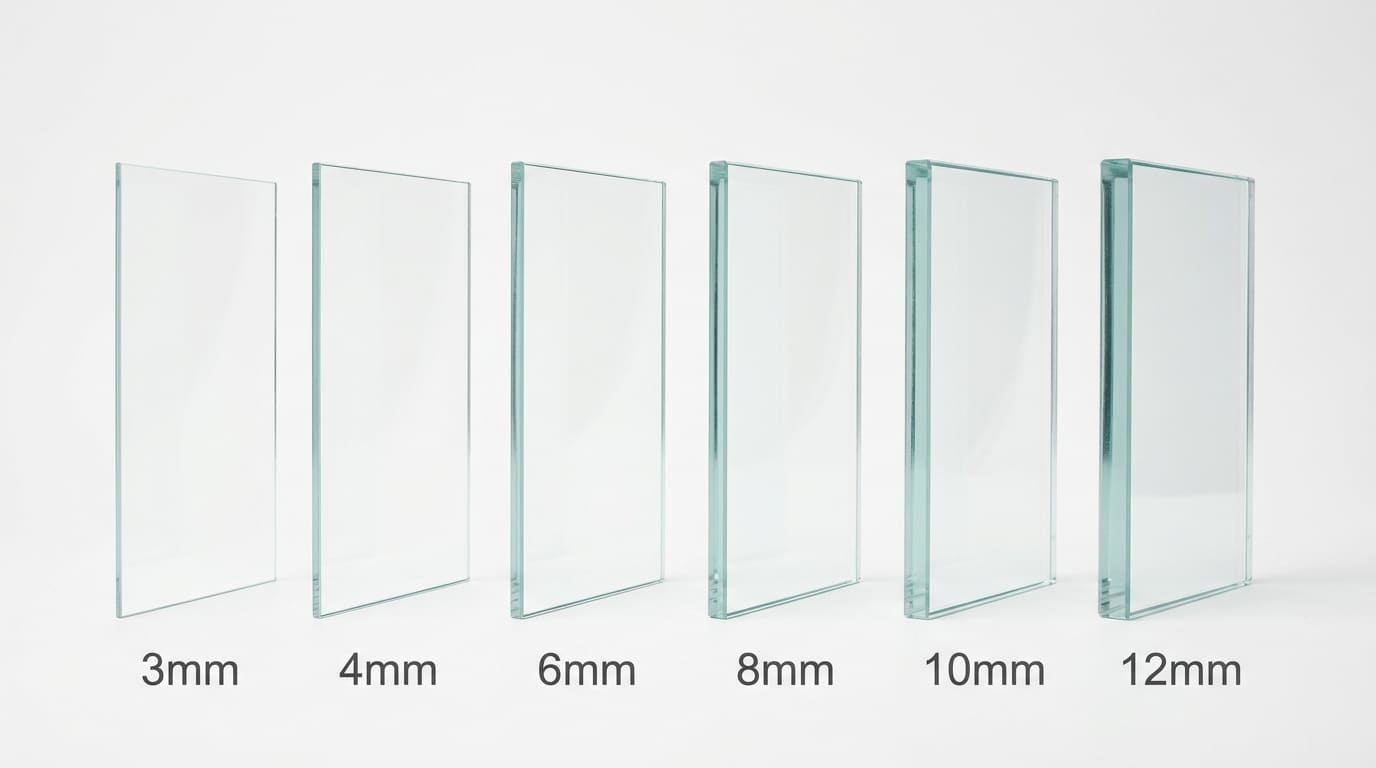
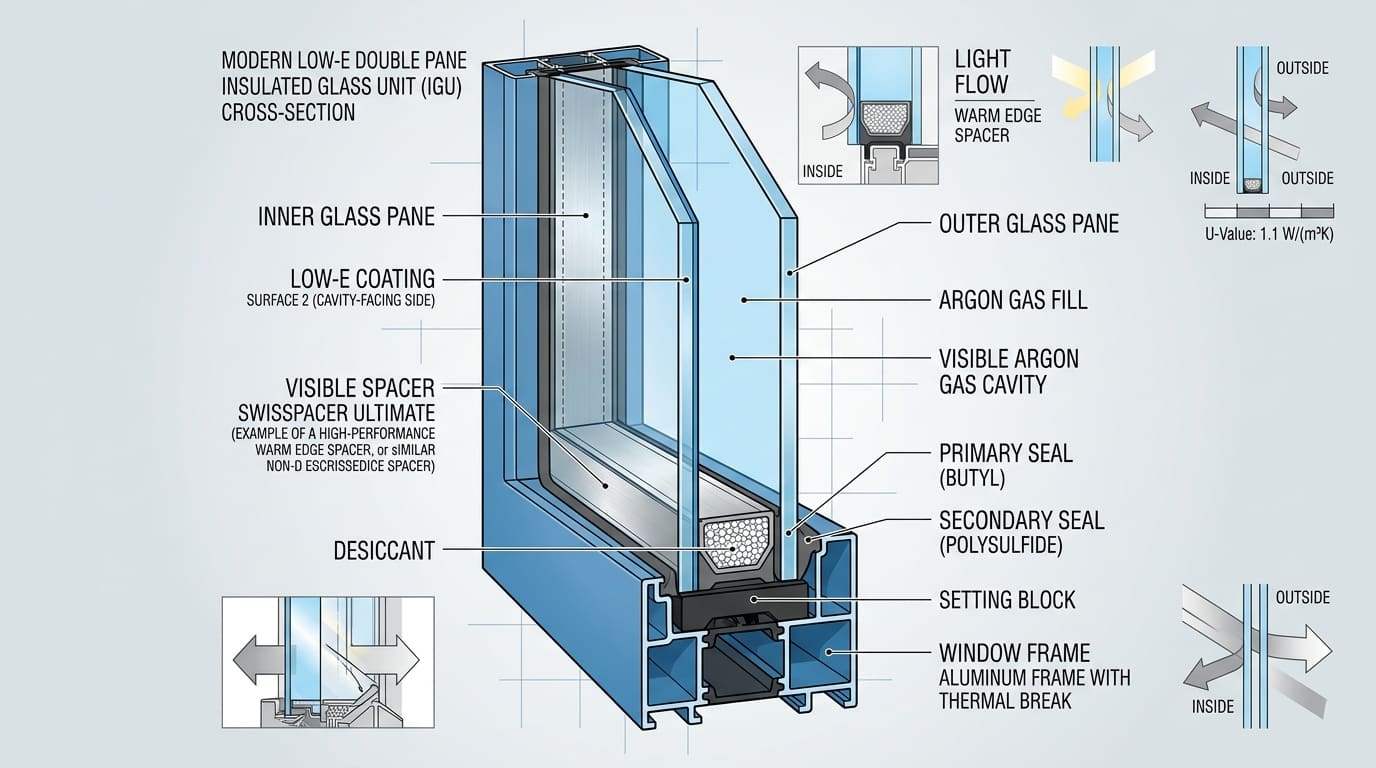
A standard single-pane window with 3mm glass typically achieves STC 18-22. A standard double-pane insulated unit (IGU) with two lites of 3mm glass and a half-inch air gap achieves STC 26-28 — a modest improvement over single pane, and often less than homeowners expect. The air gap in a standard IGU actually creates a resonance chamber that can amplify certain frequencies.
This is why a standard window replacement from single to double pane often disappoints homeowners who were hoping for dramatic noise reduction. You get meaningful improvement, but a standard IGU is not an acoustic product — it is an energy product. Acoustic performance requires deliberate specification choices.
Laminated Glass: The Most Effective Single Upgrade
Laminated glass — two lites of glass with a polyvinyl butyral (PVB) or acoustic PVB interlayer bonded between them — is the most cost-effective acoustic upgrade available for residential windows. The interlayer acts as a damping layer that breaks up sound wave transmission. An IGU incorporating one laminated lite (for example, a unit with 6mm laminated glass on the exterior and 3mm tempered glass on the interior) can achieve STC ratings of 34-38, depending on thickness and air gap design.
Acoustic-grade PVB interlayers are thicker than standard safety PVB and provide additional damping. An IGU with acoustic laminated glass on both lites and a wider air gap can reach STC 40-45 — a very significant acoustic improvement over standard double-pane units. For homes near flight paths, highway overpasses, or Metro lines, acoustic laminated IGUs are the specification that produces real quality-of-life change.
The reason laminated glass appears in hurricane zones is impact resistance, but its acoustic properties are a major secondary benefit. If you are replacing windows in a DC row house near a commercial corridor, specifying laminated glass is an upgrade that pays off every night.
Triple-Pane Glass and Acoustic Performance
Triple-pane windows — three lites of glass with two air gaps — are primarily marketed for their thermal performance (they can achieve U-factors below 0.20, superior to most double-pane units). Their acoustic performance relative to double-pane depends heavily on configuration. A triple-pane unit with three lites of equal thickness and equal air gaps can actually perform worse acoustically than a well-specified double-pane unit due to coincidence effects — all three panes resonating at similar frequencies.
A triple-pane unit with asymmetric lite thicknesses (for example, 4mm, 3mm, and 4mm, or one laminated lite) disrupts these resonance effects and can achieve STC ratings of 40-50. The premium triple-pane acoustic window products — from European manufacturers and some specialty North American brands — are exceptional noise reducers but come at significant cost. For most DMV homeowners, a well-specified double-pane unit with laminated glass delivers 85 percent of the acoustic performance at roughly half the cost.
Air Gap Size Matters
In a standard IGU, the air or gas gap between lites is typically 1/2 inch (12mm) to 5/8 inch (16mm). For acoustic performance, wider gaps — 3/4 inch (19mm) to 1 inch (25mm) — improve low-frequency sound transmission at the cost of slightly reduced insulating performance. Some acoustic IGU designs use different gases or alternate the gap widths in triple-pane units to optimize for both thermal and acoustic performance.
When we specify replacement glass for clients in noise-sensitive situations near Reagan National, the Beltway, or Metro corridors, the air gap specification is part of the conversation alongside glass thickness and lamination choices. A standard 1/2-inch air gap IGU is a different product from a 3/4-inch air gap acoustic unit with one laminated lite — and the difference is audible from the first night.
Frame Sealing and Air Infiltration
Glass specification is only half of the acoustic equation. Sound also travels through air leaks around the frame, through the frame material itself, and through the wall-to-frame interface. A perfectly specified acoustic IGU installed in a frame with poor weatherstripping or inadequate frame-to-wall sealing will underperform because sound bypasses the glass entirely through these gaps.
Before any glass-based acoustic upgrade, we assess the existing frame condition and weatherstripping. In older DC row houses and colonial-era homes in Prince George's County and Alexandria, we often find frames with significant air infiltration that accounts for a substantial portion of the noise intrusion. Sealing these gaps is a prerequisite — and often a surprisingly effective standalone measure — before glass upgrades are considered. We address both components as part of any acoustic improvement project.
Realistic Expectations
No window glass eliminates noise entirely. An STC 42 acoustic window in an otherwise-standard residential wall will reduce perceived noise significantly — traffic that was clearly audible becomes a murmur, aircraft that was clearly identifiable becomes a background rumble — but will not produce silence. For homeowners near very high-noise sources (within a few hundred feet of a major highway, or directly under an airport approach), acoustic windows are a major quality-of-life improvement but not a complete solution.
The homes that achieve truly high acoustic isolation typically combine high-STC window glass with solid-core doors, careful air sealing, and sometimes additional interior treatments. But starting with the glass — which is the weakest link — produces the highest return on investment for acoustic comfort in most DMV homes.
If noise is affecting your sleep or quality of life at home, send us photos of your current windows for a free custom quote on acoustic glass options. We work across DC, Maryland, and Northern Virginia and can specify the right glass for your specific noise situation. Call (703) 470-7867 with questions.
About the Author
Mike Reynolds
Lead Glass Technician & Owner
With over 15 years of experience in window and glass repair across the DC, Maryland, and Virginia area, Mike shares practical expertise to help homeowners and businesses make informed decisions about their glass repair and replacement needs.
Need Help With Your Glass?
Our experts are ready to help with any window or glass issue. Free estimates, same-day service available across DC, MD & VA.
Related Articles
Continue reading about guides
More Guides
View All
How to Tell If Your Window Glass Needs Repair or Replacement
8 min read
Stress Cracks in Windows: Causes, Prevention & Solutions for DMV Homeowners
7 min read
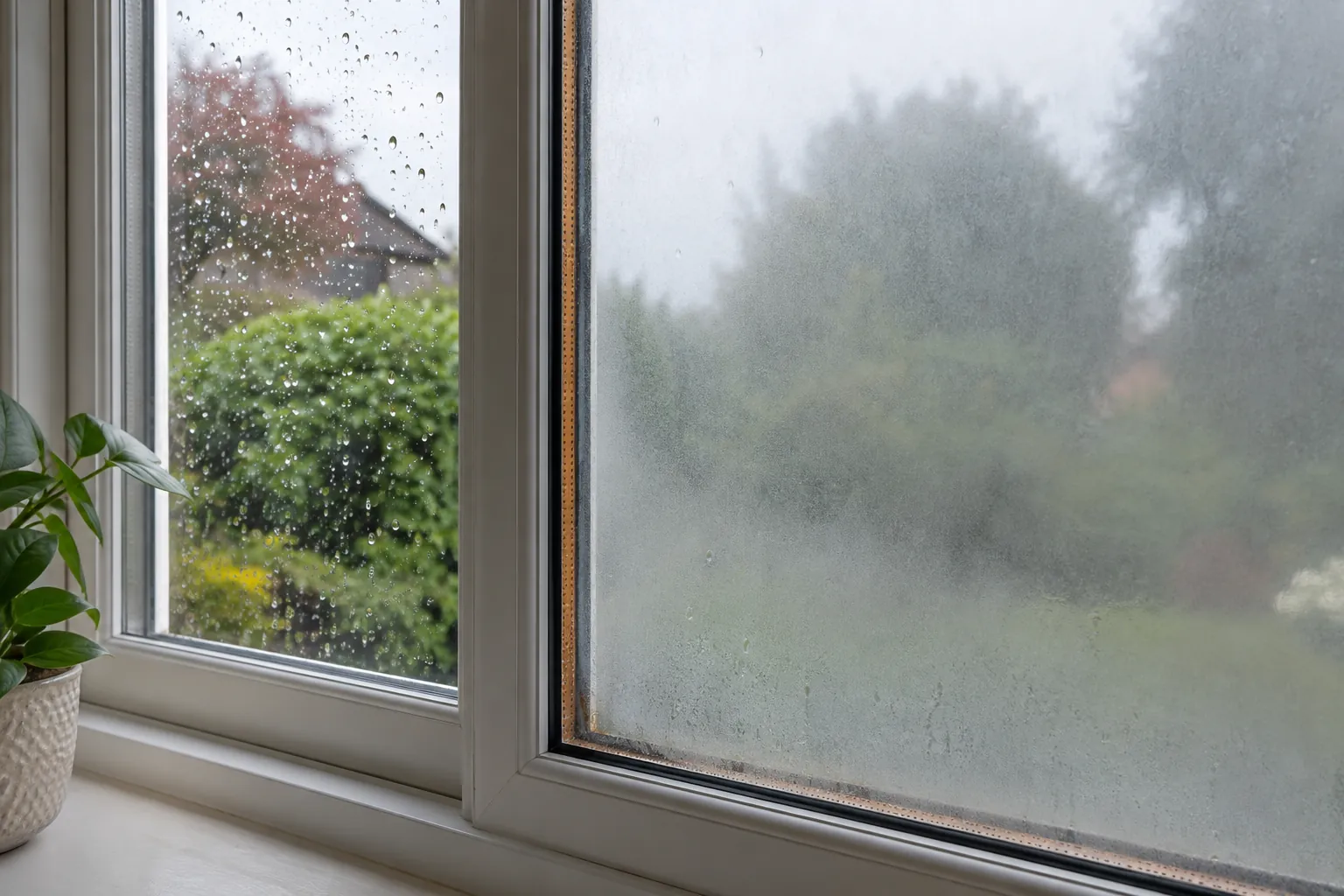
Foggy Windows: Why Double-Pane Seals Fail & What to Do About It
9 min read
Glass Replacement in Historic DMV Homes: Preservation Meets Performance
9 min readExplore More Resources
Helpful Guides
Common Problems
Related Pages
Our Services
24/7 Emergency
Board-Up & Glass
Licensed & Insured
DC, MD & VA
300+ Areas
DMV Coverage
Same-Day Service
When You Need It
Ready to Get Started?
Get a free estimate for any window or glass service across the DMV area.