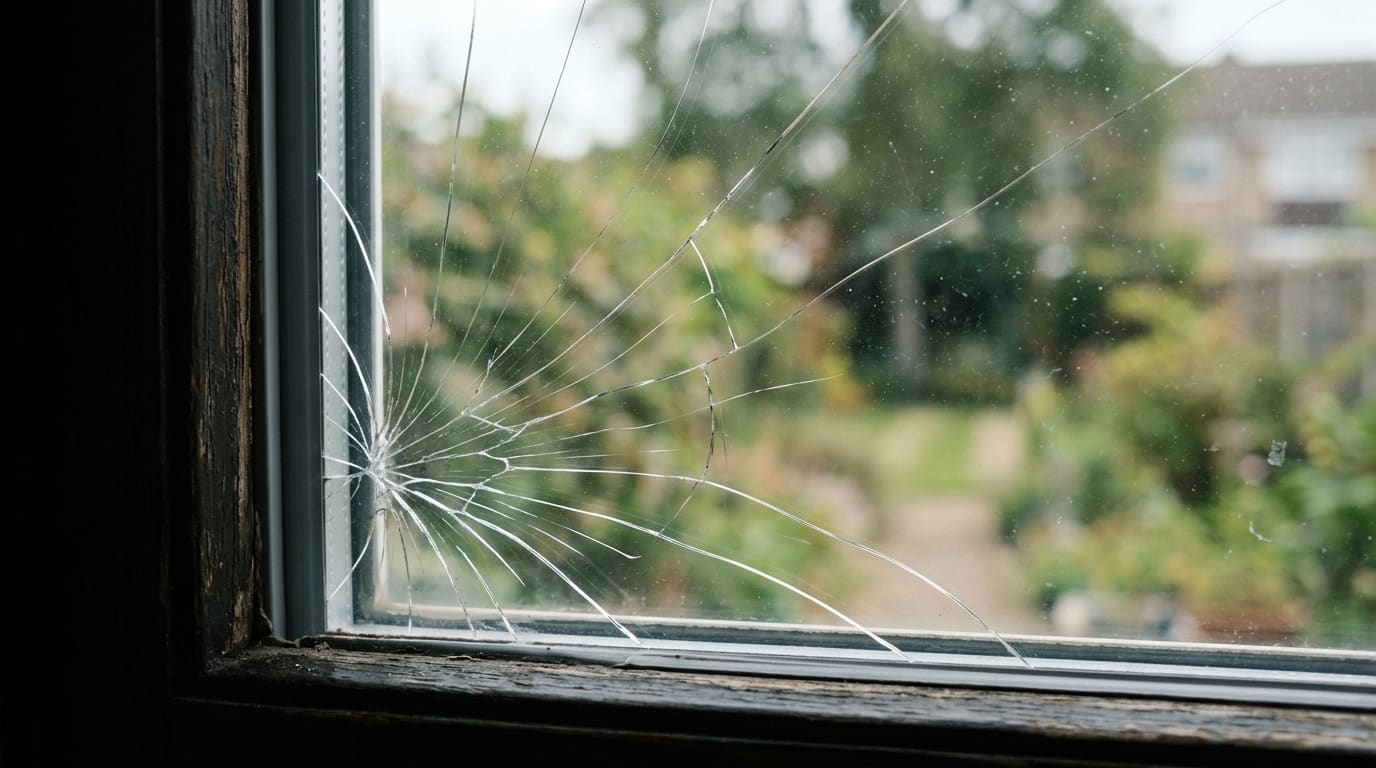
Why Tempered Glass Sometimes Breaks on Its Own: Nickel Sulfide, Thermal Stress, and Edge Damage
You walk into your bathroom and find the shower door in a pile of small glass fragments — no impact, no obvious cause, the glass just broke on its own. Spontaneous tempered glass breakage is real, it is rare, and it has specific causes that are worth understanding.
Mike Reynolds
Lead Glass Technician & Owner
In This Article
How Tempered Glass Can Break Without Apparent Cause
Tempered glass is manufactured to be significantly stronger than standard annealed glass — roughly four times stronger under most loading conditions. This strength comes from the tempering process: the glass is heated to approximately 1,200°F and then rapidly cooled with forced air jets, which creates a surface compression layer and a core tension layer. The surface compression is what provides the strength — forces applied to the glass surface must overcome the pre-existing compression before they can put the glass into tension and initiate a crack.
The same thermal treatment that makes tempered glass strong also creates its distinctive failure mode. When tempered glass does fail — from any cause — the entire pane shatters simultaneously into thousands of small, roughly cuboid fragments. This is the characteristic "pebble" breakage pattern of tempered glass, and it happens because when the surface compression is finally breached at any point, the stored energy in the tension core is released instantaneously across the entire pane. There is no progressive cracking, no warning — just a sudden, loud, complete shattering.
Spontaneous breakage — failure without any visible external impact — occurs when the internal stresses in the glass reach a critical level without an external force providing the final trigger. Three mechanisms account for the vast majority of spontaneous tempered glass failures: nickel sulfide inclusion expansion, thermal stress concentration, and edge damage that has created a stress concentration that grows over time until it triggers the pane.
Nickel Sulfide Inclusions: The Rarest but Most Discussed Cause
Nickel sulfide (NiS) inclusions are microscopic particles that form in glass during the float glass manufacturing process when nickel contaminants — from manufacturing equipment, stainless steel components, or nickel-containing raw materials — combine with sulfur in the glass melt. These particles are trapped within the glass as it cools and solidifies, typically measuring 0.1 to 0.5 mm in diameter and invisible to casual inspection.
The problem occurs because nickel sulfide exists in two crystalline forms — alpha and beta — that have different volumes. At the high temperatures of the tempering process, the NiS particles are in the alpha phase. After tempering, they remain in the metastable alpha phase as the glass cools rapidly. Over subsequent months and years, the NiS particles slowly convert to the larger-volume beta phase. This conversion creates a small but growing expansion within the glass that, when the NiS particle is located in the tension core of the tempered glass panel, eventually exceeds the glass's ability to contain the expansion stress and triggers spontaneous breakage.
The industry response to NiS-related spontaneous breakage is heat soaking — a quality control process where tempered glass panels are held in an oven at approximately 290°C for several hours after tempering. This accelerates the NiS phase conversion during the controlled environment of the heat soak test, causing any susceptible panels to break during the test rather than after installation. Heat-soaked tempered glass has a dramatically reduced incidence of NiS-related spontaneous breakage in service. For safety-critical applications — glass floors, glass railings, pool fencing, overhead glazing — heat-soaked tempered glass is the appropriate specification.
Thermal Stress Spontaneous Failure
Thermal stress failure in tempered glass occurs when a temperature gradient across the glass panel becomes severe enough to create stress exceeding the glass's tensile strength. This can happen in tempered glass just as it can in annealed glass, but the failure mechanism is different. In annealed glass, thermal stress initiates a crack that propagates across the pane. In tempered glass, if the thermal stress reaches the tension core in sufficient magnitude, it can trigger the simultaneous shattering characteristic of tempered glass failure.
The conditions that create problematic thermal gradients in tempered glass are the same conditions that create stress cracks in annealed glass: partial shading by a blind or external obstruction that creates a sharp temperature boundary across the pane, a heating vent blowing directly onto one portion of the glass, or partial sun exposure in the early morning before the entire pane has warmed. South and west-facing tempered glass panels in the DMV are most susceptible in the late afternoon when the sun angle is low and can partially illuminate a panel while adjacent sections remain shaded by overhangs or neighboring structures.
Edge Damage: The Most Common Real-World Cause
In practical terms, the most common cause of what presents as spontaneous tempered glass breakage in the DMV is existing edge damage — a chip, nick, or scratch at the glass edge that was present at installation or occurred at some point after installation — that has created a stress concentration point in the compression-tension boundary region at the glass edge. Tempered glass edges, where the compression-tension transition occurs, are the most vulnerable location for crack initiation.
Over time, thermal cycling, building movement, and vibration can cause the stress at a damaged glass edge to grow incrementally until it reaches a critical level and triggers spontaneous failure. The damage may have been present and benign for years before the failure occurs — a minor edge chip from installation handling that never caused concern becomes the nucleus of a catastrophic failure triggered by an unusually cold morning or a slightly harder door slam than usual.
This is why post-installation handling of tempered glass is critical. A chip at the glass edge from a sliding door panel being lifted with a suction cup that slips, or from a framing nail that nicked the edge during installation, can set up a delayed failure weeks, months, or years later. For high-risk tempered glass applications — shower doors, patio door panels, glass railings — inspecting the edge condition during installation and immediately after any handling is good practice.
What to Do When Spontaneous Breakage Occurs
When tempered glass fails spontaneously, the immediate priority is preventing injury. The small fragments are not sharp-edged like annealed glass shards, but they are abundant and can cover a large area. Keep people and pets away from the immediate area. Wear closed-toe shoes before approaching the glass pile. Sweep up fragments carefully and vacuum the area thoroughly — fine glass particles can scatter significantly from the main pile.
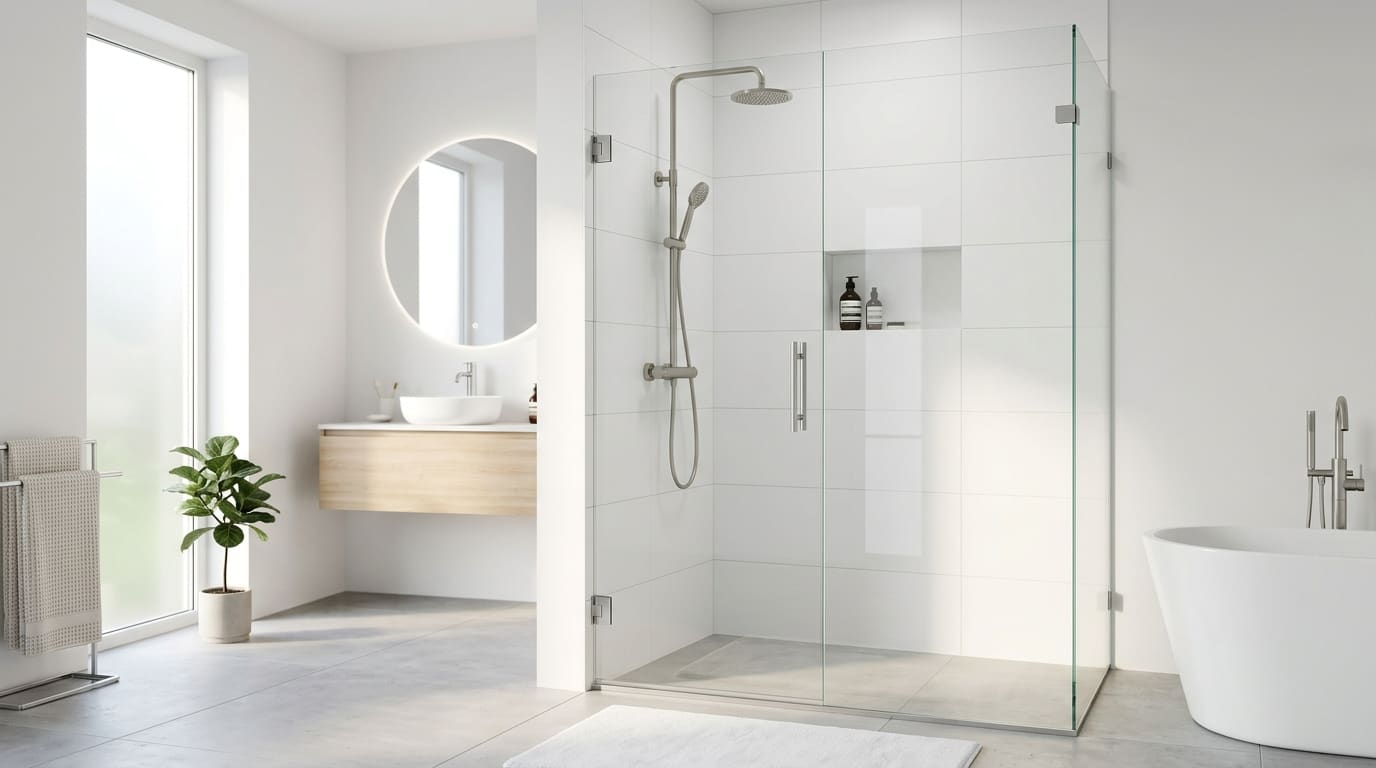
For spontaneous failures in a location where the glass was specified as safety-critical — shower enclosures, door glass, railings — the application must be considered out of service until replacement glass is installed. A shower enclosure without its door presents both a safety hazard and a water management problem. Temporary measures — shower curtain on a rod, barrier tape around a railing opening — provide interim safety while glass replacement is arranged.
Document the failure with photographs before cleanup if possible — the fragment pattern and the location of the fracture origin (visible as a small butterfly or star pattern in the fragment pile) can sometimes identify the cause. For glass under manufacturer warranty or a recent installation, documentation supports a warranty or liability claim. Contact Virginia Glass Windows at (703) 470-7867 for emergency glass replacement following spontaneous failures — we maintain stock of standard shower door and patio door tempered glass panels for same-week installation in most cases.
About the Author
Mike Reynolds
Lead Glass Technician & Owner
With over 15 years of experience in window and glass repair across the DC, Maryland, and Virginia area, Mike shares practical expertise to help homeowners and businesses make informed decisions about their glass repair and replacement needs.
Need Help With Your Glass?
Our experts are ready to help with any window or glass issue. Free estimates, same-day service available across DC, MD & VA.
Related Articles
Continue reading about safety
More Safety
View All
Security Glass Options for DMV Homes: Tempered, Laminated & Impact-Resistant
8 min read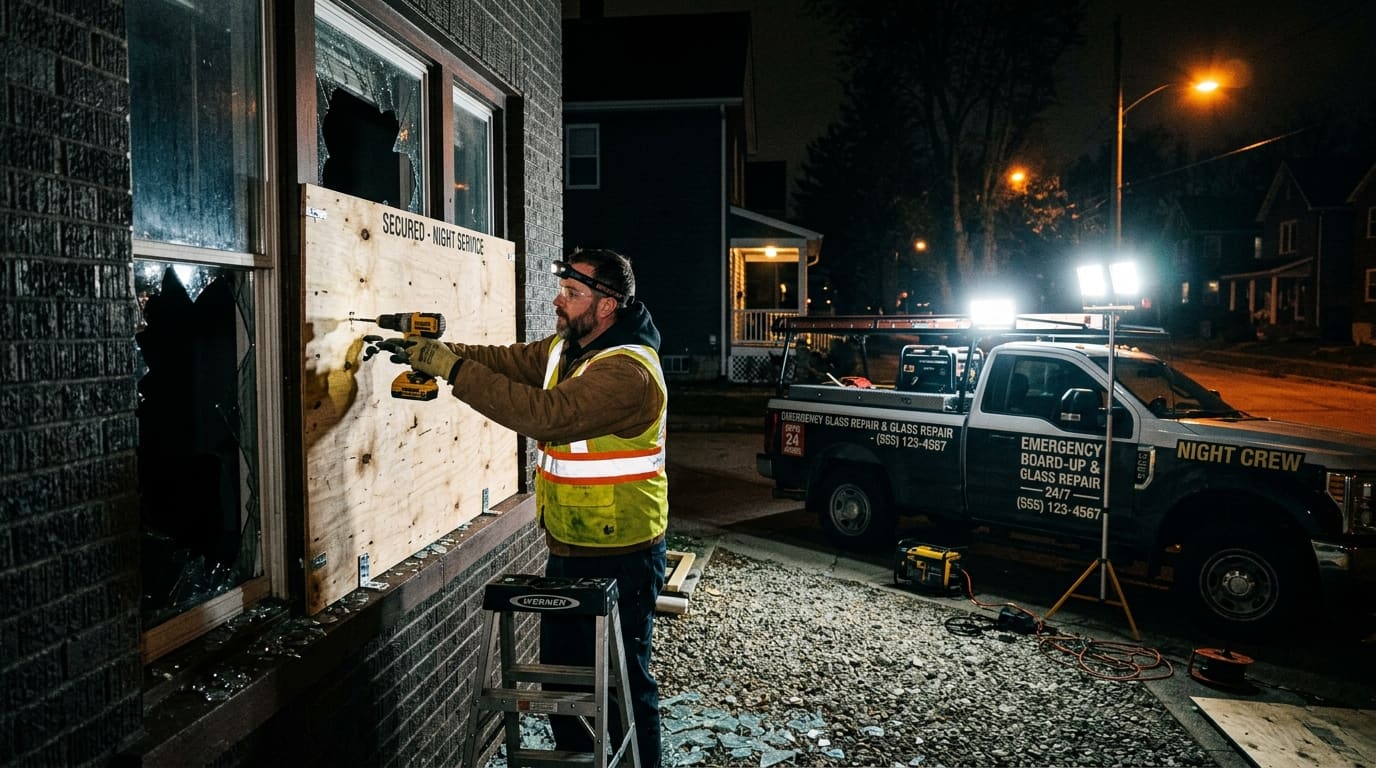
Emergency Window Repair: What to Do When Your Glass Breaks
6 min read
Glass Safety Standards & Building Codes: What Homeowners Need to Know
7 min read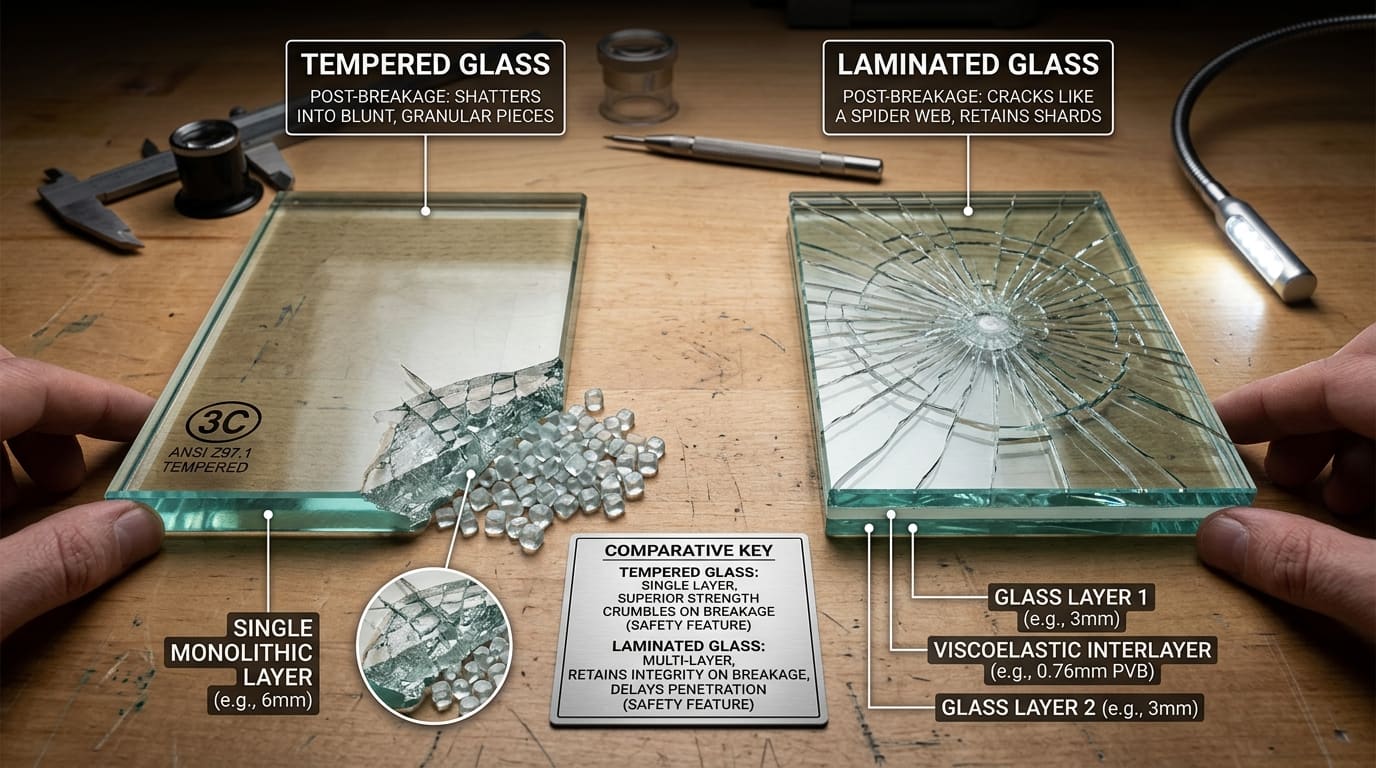
Glass Fence & Railing Code Requirements: Pool, Deck & Balcony
6 min readExplore More Resources
Helpful Guides
Common Problems
Related Pages
Our Services
24/7 Emergency
Board-Up & Glass
Licensed & Insured
DC, MD & VA
300+ Areas
DMV Coverage
Same-Day Service
When You Need It
Ready to Get Started?
Get a free estimate for any window or glass service across the DMV area.