Choosing Glass for Bathroom Privacy: Frosted, Textured, Patterned, and Smart Glass Options
Bathroom glass is one of those decisions that homeowners overthink in the wrong direction — obsessing over which frosted pattern looks best while ignoring the actual privacy performance. Here is a practical guide.
Mike Reynolds
Lead Glass Technician & Owner
In This Article
The Privacy Paradox of Bathroom Glass
I want to start with a confession that surprises most clients: fully clear glass, used well, can actually provide more functional privacy than some frosted glass options. I have installed a lot of both, and I have done the standing-outside-looking-in test more times than I can count. Certain popular "frosted" glass patterns — particularly light acid-etched finishes and some sandblasted patterns — diffuse light and obscure detail in bright conditions, but become noticeably more transparent when there is backlighting (someone standing in front of a brightly lit mirror, for example). This is the privacy paradox: the glass that looks private on the showroom floor may perform differently in actual bathroom lighting conditions.
The practical implication is that privacy glass for bathrooms needs to be selected based on actual obscuration level, not aesthetics. And obscuration level varies significantly between product types. Let me walk through the real options from least to most private, because the hierarchy is not always obvious.
A note on the DMV application context: in DC rowhouses and Capitol Hill townhouses, bathroom windows often face directly onto a neighboring property at close range. In Bethesda and McLean single-family homes, the bathroom may face a neighbor's yard. In condo buildings throughout the region, bathroom windows face courtyards or light wells where multiple units have visibility. The privacy requirement is real and the social stakes of getting it wrong are high — this is not an area to underinvest in obscuration.
Frosted and Acid-Etched Glass: Levels Matter
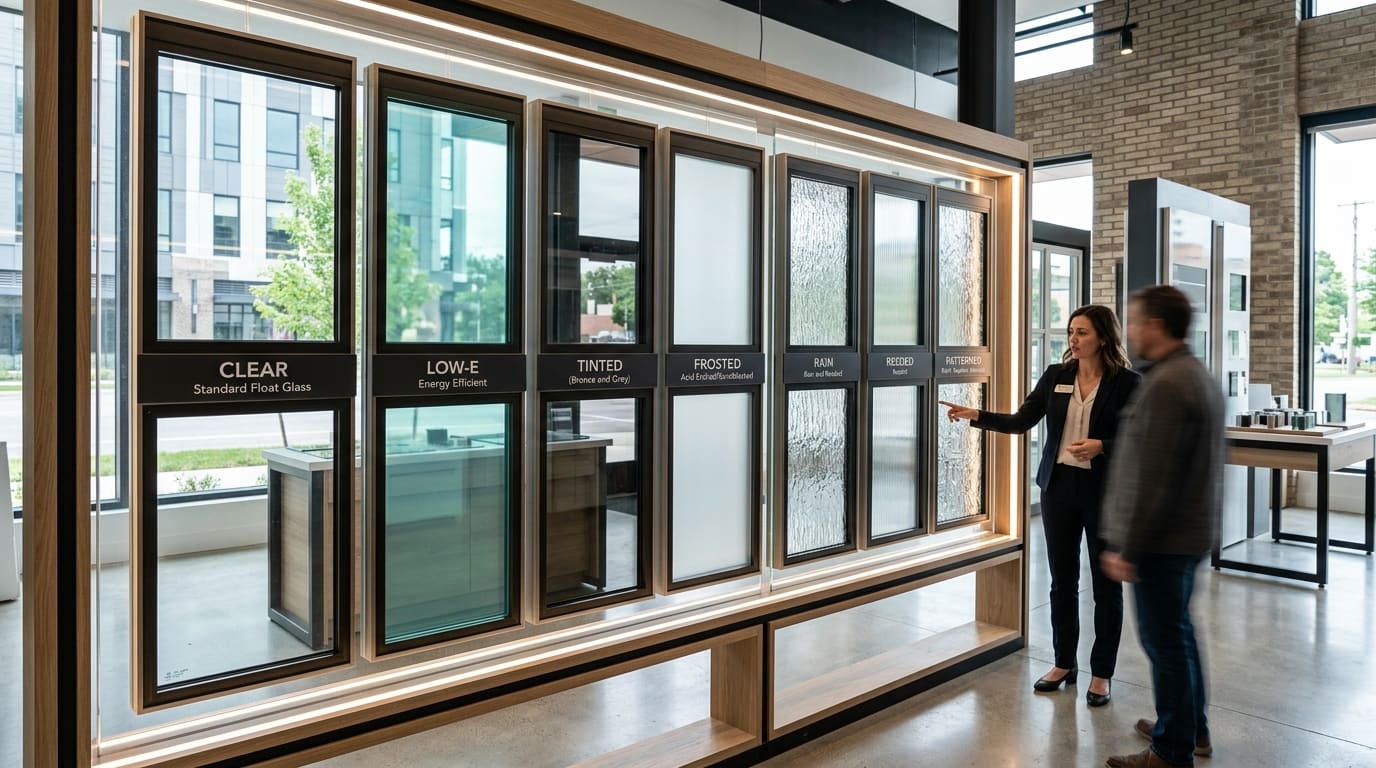
Frosted glass is a category, not a specification — and the variation within the category is enormous. At the light end, a subtle acid-etch finish gives glass a soft, translucent appearance that lets in diffuse light but provides only minimal privacy. At the heavy end, a deep sandblasted finish is nearly opaque, transmitting light but providing essentially zero through-glass visibility in any lighting condition. Most of what gets sold at home improvement stores under the label "frosted glass" is in the light-to-medium range — adequate for moderate privacy applications but not for primary bathroom windows at close range.
For shower enclosures, we typically recommend a consistent medium-to-heavy frosted finish — enough to obscure the full body even in backlit conditions. The way to evaluate this in person is to look at the glass in a well-lit showroom: stand at the typical viewing distance for your situation and check whether you can see distinct outlines through the glass when someone is on the other side. If you can, the level of frosting is insufficient for your application.
Frosted glass for bathroom windows should be thought of separately from shower enclosure glass. For a window above a bathtub or toilet with the nearest neighbor fifteen feet away, a medium etch is likely adequate. For a window at arm's reach from a neighboring building's windows — which is a real situation in rowhouse blocks in Adams Morgan, Petworth, and Columbia Heights — you want heavy frosting or an opaque glass option. We can test samples against your specific situation before you commit.
Patterned and Textured Glass: Privacy Plus Character
Patterned glass — glass with a surface texture pressed into one face during manufacturing — is an underused option in DMV bathrooms, which is a shame because the best patterns are beautiful and provide excellent privacy that does not depend on frosting level. Textured patterns like reeded (vertical stripes), fluted, and Baroque provide strong visual distortion that obscures through-glass visibility at virtually any lighting level. Unlike frosted glass, textured glass privacy does not degrade under backlighting because the distortion is geometric rather than diffusive.
Reeded glass — which has parallel vertical channels pressed into the surface — has had a significant design moment in the last few years and is now being specified in bathrooms, shower enclosures, interior partitions, and cabinet door panels throughout the DMV. We have installed it in renovations in Georgetown, Kalorama, Chevy Chase DC, and in new construction throughout Arlington County. It provides excellent privacy while transmitting good amounts of light, and it photographs beautifully — which matters for clients who care about their home's resale appeal. The vertical lines create a sense of height in a space and complement both contemporary and traditional interiors.
Fluted glass (similar to reeded but with rounded profiles) and various rolled patterns (Niagara, Delta Frost, Master Pane) are available in several thickness options and can be used in both window and shower enclosure applications. Shower use requires tempered glass, which we can provide in most patterned options. One important note: some patterned glasses are more difficult to keep clean than smooth glass because the texture accumulates soap scum and mineral deposits in the channels. Flatter textures (Niagara, for example) are easier to clean than deeply ridged ones. For shower glass specifically, easy-clean coatings that resist mineral buildup are available and worth adding.
Smart Glass for Premium Bathrooms
PDLC smart glass — which switches between clear and frosted at the touch of a switch — is appearing in upscale DMV bathroom renovations with increasing regularity. The appeal is obvious: clear glass when you want the space to feel open and light-filled, instant privacy at the touch of a switch or phone tap. In a master bathroom in a McLean or Bethesda renovation, the ability to have a clear glass shower enclosure that switches to opaque for privacy is a genuine luxury feature that clients remember and appreciate every day.
The practical considerations for bathroom PDLC: the electrical connection needs to be planned into the renovation, the film must be appropriate for wet environments (bathroom-rated PDLC is available and we specify only those products in moisture-exposed applications), and the frosted state of PDLC glass provides full privacy — it is not a light-frosted wash but a true white opaque appearance. In the "off" (unpowered) state, PDLC glass is frosted, so a power failure defaults to the private state rather than the clear one — which is reassuring for bathroom applications.
Smart glass makes most sense for shower enclosures and interior bathroom partitions where the design intention is an open-feeling, high-transparency space that can be made private on demand. For exterior bathroom windows, conventional frosted or textured glass provides more reliable weather performance and does not require electrical wiring. We have done enough smart glass bathroom installations in the DMV to have strong opinions about what works and what creates maintenance headaches — call (703) 470-7867 and we can walk you through the real-world performance before you commit to a specification.
Shower Enclosure Glass: Safety Requirements and Options
All glass used in shower enclosures — doors, fixed panels, returns — must be safety glass by code in all three DMV jurisdictions. Either tempered glass or laminated glass meets the requirement, and both have advantages worth knowing about. Tempered glass is the standard choice: it is strong, relatively easy to fabricate in various patterns, available in clear and frosted versions, and inexpensive compared to laminated. The one significant downside of tempered glass is spontaneous breakage — a very small percentage of tempered glass panels break without apparent cause due to nickel sulfide inclusions in the glass. In a shower enclosure, a spontaneously shattered tempered panel is a dramatic and inconvenient event even though the small pebble-like fragments are far less hazardous than a large shard.
Laminated shower glass addresses the spontaneous breakage concern: the PVB interlayer holds the glass together if it breaks, preventing the shower floor from being covered in fragments. It is heavier, somewhat more expensive, and available in fewer surface textures than tempered, but for frameless enclosures and large panels, the peace of mind is worth considering. We recommend laminated glass for full-height frameless shower panels over 72 inches tall, for sloped ceiling applications where falling fragments would be a particular concern, and for clients who have experienced tempered glass spontaneous breakage before and want to avoid the repeat experience.
About the Author
Mike Reynolds
Lead Glass Technician & Owner
With over 15 years of experience in window and glass repair across the DC, Maryland, and Virginia area, Mike shares practical expertise to help homeowners and businesses make informed decisions about their glass repair and replacement needs.
Need Help With Your Glass?
Our experts are ready to help with any window or glass issue. Free estimates, same-day service available across DC, MD & VA.
Related Articles
Continue reading about guides
More Guides
View All
How to Tell If Your Window Glass Needs Repair or Replacement
8 min read
Stress Cracks in Windows: Causes, Prevention & Solutions for DMV Homeowners
7 min read
Foggy Windows: Why Double-Pane Seals Fail & What to Do About It
9 min read
Glass Replacement in Historic DMV Homes: Preservation Meets Performance
9 min readExplore More Resources
Helpful Guides
Common Problems
Related Pages
Our Services
24/7 Emergency
Board-Up & Glass
Licensed & Insured
DC, MD & VA
300+ Areas
DMV Coverage
Same-Day Service
When You Need It
Ready to Get Started?
Get a free estimate for any window or glass service across the DMV area.